|
|
 |
Dusted Reviews
Artist: Anthony Braxton Album: Two Compositions (Trio) 1998 Label: Leo Review date: Apr. 8, 2003 |
|
|
|
|
An Exhaustive Trance
Ah, Mr. Braxton! You can almost set your watch by the regularity with which the great man comes up with a new release. One of the most rigorously self-documenting creative musicians on the scene, Braxton’s output in the last seven or eight years is not as consistently mind-boggling as it once was. Basically, listeners are deeply divided about the merits of Braxton’s Ghost Trance Music (GTM). By way of explanation for those relatively unfamiliar with Braxton – who I regard as one of the most important musicians of the past several decades, regardless of genre – since his early experiences with Chicago’s Association for the Advancement of Creative Musicians, Braxton has integrated a dizzying assortment of influences (from Coltrane and Ayler to doo-wop and Sinatra to Cage and Stockhausen by way of Marsh and Konitz) in several compositional systems of his own devising. These include the language-based musics of the late 1960s and early 1970s, the collage and pulse-track musics that he explored through the early 1990s, and most recently the GTM.
GTM compositions are most known for the very long melodies that are played in strings of eighth notes (generally in unison by at least two players). Playing with timbre, tempo, and texture, the musicians generally unsettle and redirect the melodies (as the reedists do on these performances with great vigor). During this process, GTM compositions generally begin to unpack structural elements more familiar within Braxton’s music: they may explore a particular technical language (e.g. overblowing or legato), or they may explore tertiary compositions from elsewhere in Braxton’s system (generally each GTM performance may contain four secondary compositions). Braxton believes that this combination allows melodic, rhythmic, textural, and structural variation in a way that is indeterminate and open-ended. The overriding goal in this approach is, as Braxton noted in 1995, to explore “a form of meditation that establishes ritual and symbolic connections [which] go beyond time parameters and become a state of being in the same way as the trance musics of ancient West Africa and Persia.”
Okay. The problem is, the GTM haven’t always yielded such lofty or ecstatic pleasures. Though some listeners rave about the early recordings on the composer’s own (apparently defunct) Braxton House label, I have in the past found the GTM to be quite wooden and lacking the dynamism that I love in Braxton’s music. Certainly it is challenging, worthy of study, and contains pleasures. But I have found the successes few and far between (the real killer being Composition No. 247, also on Leo Records).
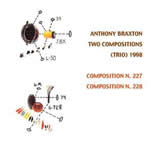
This double-disc recording is from April 17, 1998, roughly halfway through the life of the GTM. Each disc contains a single, very long composition for reeds trio (true Braxophiles will rightly think here of 1979’s For Trio, where Brax explored similar instrumentation with Joseph Jarman, Roscoe Mitchell, Henry Threadgill, and Douglas Ewart). On the first – “Composition 227” – Braxton is joined by Chris Jonas (who is developing quite a reputation with his group The Sun Spits Cherries, among others) and David Novak. On the second – “Composition No. 228” – the leader is accompanied by Jackson Moore and Seth Misterka. Like their mentor, each of these fellows is a multi-reedist; the capacity of each musician to switch instruments rapidly – ranging from the ocarina-like “plastic Indonesian tourist instrument” to leviathan contrabassoon (low-end freaks will dig the savage opening to “228”, with twinned baris joining bass sax) – gives this music quite a bit of color. Unlike many GTM compositions, there is breathing room and generous space in these pieces. Indeed, some of the loveliest triple-reed interplay comes during these pauses, where burbling klangfarbenmelodie moments proliferate. There are also thoughtful solos throughout these performances – some good bassoon statements from the relatively-unknown Novak (who also occasionally contributes on celesta), and some particularly raunchy stuff from the excitable Misterka and Moore (some excellent circular breathing and bird-chirping). But alas, I still found it tough going overall. I appreciate the intellectual and (especially) physical rigor these pieces require. And occasionally they are exhilarating, as the players tie themselves in and out of very dense knots of notes (the honking elephantasy of “228” is more pleasing in this regard). But there’s not a whole lot about this recording that will make me select it from among the 50 or 60 other Braxtons I treasure.
By Jason Bivins
|




 Solo (Milano) 1979