|
|
 |
Dusted Reviews
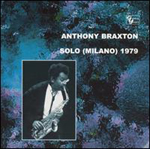
Artist: Anthony Braxton Album: Solo (Milano) 1979 Label: Leo Review date: Jan. 23, 2005 |
|
|
|
|
This volume from Leo’s Golden Years of New Jazz imprint presents the second concert Braxton performed over a three-day period in Milano in January 1979. It is from one of the great reeds player’s most fertile and engaging periods. Across his long and multi-faceted career, Braxton has always returned to solo performance, usually with just his alto sax on stage with him (and who can forget that it was his stunning, two-LP salvo For Alto that launched him into creative music in the first place?). From his debut up to some of his recent releases, Braxton’s solitary music making has served as both a workshop for his latest compositional and improvisational ideas and the crucible for his intelligent and warm personal expressions. As always, the majority of the pieces from this performance are Braxton’s own, though he mixes in a number of his favorite standards.
Around the time of the recording, Braxton was stretching beyond the “language series” compositions of the early 1970s – where each piece basically explored a single facet of saxophone technique – into a more integrative approach, represented by the 90 and 100 series of his compositions (many of the latter series, notably including “Composition No. 113,” were designed for long-form solo performance). The opening “99b” explores this combinative approach, melding a number of wide intervallic leaps with harsh staccato phrases. And the latter half of the concert gives the listener another opportunity to hear Braxton integrate ideas and techniques, as several pieces from the 100 series take a slower, more measured approach that focuses on slowly shifting tone groupings.
Still, if you like it a bit hotter, pay close attention to the first half of the concert and the 70 series pieces: the semi-Phrygian exercise of “77e,” the insane arpeggios of “77g,” and the harsh mauling of “77d.” For those keeping track of the standards, Braxton here takes a crack at “On Green Dolphin Street,” “They Say That Falling in Love is Wonderful,” Miles’ “Half Nelson,” “’Round Midnight,” and “Lush Life.” Braxton tends to ramble a bit more when performing traditional materials, perhaps because of the more restrictive harmonic range or perhaps because he strives too much to prove himself, and these pieces are – while enjoyable – not as compelling as his own compositions.
So all in all, this is a typical Braxton solo performance from a peak period. Until somebody gets around to securing the rights to Braxton’s 1970s work for Arista Freedom – and with it, the extraordinary solo albums he recorded for that label – this is, along with its Golden Years companion and the same label’s Solo (Koln) 1978, one of the best documents of Braxton’s solo work from this time.
By Jason Bivins
|





 Two Compositions (Trio) 1998