



|
|
|
|
|
|
|
|
|
|
||||||
| |||||
|
|
||||||||||||||||||||||||||||||||||||||||||
|
|
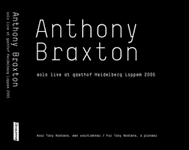
The past year has been an extremely prolific one for the ever prolific Anthony Braxton. A couple of discs on Leo, three concert recordings from Victo, the gargantuan Iridium box that closed the book on Braxton’s Ghost Trance music … have I missed anything? Now comes this four-disc set of live recordings from 2005, making a more convincing case for Braxton’s solo playing than any other document I’ve heard.
While the genius and invention of such seminal albums as For Alto (1968) and Compositions Series F (1972) can not be disputed, Braxton’s solo work has always seemed a distant mountain to be climbed rather than something in which to revel. To this long-time fan, its austerity springs from a compositional language and a style of playing that eschew and embrace tradition in what appeared as a strangely uncomfortable symbiosis. Live at Gasthof Heidelberg succeeds in part because of the way these pieces were recorded, but also because Braxton’s approach to his material has broadened and deepened.
The music was obviously presented in an intimate space, and those easily distracted by audience noise should be warned that several attendees ruin pregnant pauses with acts of bronchial terrorism. The music is victorious however, and the close recording captures every detail of Braxton’s alto work with extraordinary clarity and vividness, from crystalline pianissimo to devastating honks and shrieks. Listen to the first three notes of “Composition 307A” for the extreme subtlety of the recording.
Not content, Braxton interjects peaks and valleys of vocalization into several of the unfolding sound complexes. On the other end of the spectrum, “Composition 308G” opens with a crushing study of machine-gun articulation that still runs the dynamic gamut, each rise and fall in volume a minor miracle as the rat-a-tat rapid fire notes continue unabated.
Similar superimpositions inform the whole set. “Composition 307B” is replete with key clicks and short bursts of interregistral sound, but space is also a key factor. “Composition 307G” examines vibrato as timbral operator rather than as a mere ornament. Overall, while the recording certainly captures every nuance, there seems to be more moment to moment change in Braxton’s rhetoric as he creates a mystical web of recurring long tones and terse timbral explorations, akin to his idol Stockhausen’s moment forms.
The set functions, in fact, like a large-scale moment form; standards bespeak tradition, and they are interpolated cleverly throughout the set – nothing new in the Braxton discography but singularly effective in this context. “You Go to My Head” comes off especially well, capturing, in microcosm, the excitement and innovation evident throughout this important issue. For those interested in exploring Braxton’s solo repertoire (and despite its cost), I can think of no better place to start. By Marc Medwin
|
||||||||||||||||||||||||||||||||||||||||
|
||||||||||||||||||||||||||||||||||||||||||
| |||||


 Two Compositions (Trio) 1998