|
|
 |
Dusted Reviews
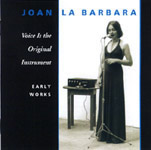
Artist: Joan La Barbara Album: Voice is the Original Instrument Label: Lovely Review date: Aug. 7, 2003 |
|
|
|
|
Strumming the Vocal Harpsichord
It’s difficult to conceptualize the idea of an extended technique for the human voice. “Extended technique” implies an aesthetic of formalization and mastery, a kind of basic vernacular that the extended technique ignores. With physical instruments, this is simple; they all have distinctive techniques, so that playing a guitar with drumsticks between the strings, using a double-bass as a percussion instrument, and blowing so hard through a saxophone that the pitch bends and distorts are all easy to imagine as being beyond the norm. But the voice must be considered differently. Unlike other instruments, the voice is inherent, something that has been used by virtually every human being who has lived. Surely the millennia of human development across so many unique cultures has exhausted its possibilities. However when examining Western culture, many of these techniques have been either lost or ignored. The rise of opera led to the adoption of a specific style of vocal performance that has dominated Western culture until only this past century and whose influence is still felt. Taken in this context, “extended technique” for the voice becomes a reasonable possibility.
Joan La Barbara is perhaps the foremost proponent and greatest virtuoso of extended vocal technique of our era. Starting in the 1970s, she made a name for herself by squeaking, moaning, purring, cawing, growling, etc, sounds that the avant-gardists of the era couldn’t get enough of. She premiered works by Robert Ashley, Morton Subotnick, Morton Feldman, Philip Glass, and James Tenney, many of which were written specifically for her and her vocal abilities. This two-disc set comes from that era; nothing presented here was created later that 1980.
The discs each feature a different side of her works. The first presents what are essentially etudes, albeit ones that sound like no etude ever written. Be it a haunting meditation on all the possible timbres and tones that can be achieved on a single pitch, a disconcerting sensory deprivation exercise, an attempt at circular breathing while singing, or an exercise in multiphonics (singing multiple tones at one, also known as overtone singing or throat singing, a common feature of the indigenous vocal music of Mongolia, specifically in Tuva), La Barbara comes to each with a playful excitement. Her fascination with the overlooked corners of the voice is quickly apparent. The most amazing moment of this disc is when you realize that there is no overdubbing, that everything here was created and recorded in real time with just her vocal chords as the source.
The second CD takes the ideas explored in the first and applies them. By layering her disparate vocalizations, La Barbara creates what she calls “Sound Paintings” or “Sound Dances.” Unlike the first disk studies, these are fully fleshed out compositions with structure, development, and direction. The electronics that she uses make for an interesting contrast with the primitive sounds coming from her mouth. While some of the spontaneity and excitement of the first disk might be gone (with the noticeable exception of “quatre petites bêtes” which is like a Looney Toon skit by cavemen), she has a keen ear for layering and does so with remarkable skill.
Fundamentally, La Barbara is questioning the nature of Western sophistication. Do operatic tenors and sopranos really deserve the attention they get as the epitome of human vocal capabilities? Why be restrictive? Or even mature? Like many of the sounds that come out of the avant-garde, La Barbara’s voice is the result of embracing the freedom and curiosity of a young child and critically considering the yelps and howls they make. The best music comes only when you’re willing to relax and not take yourself too seriously.
By Dan Ruccia
|




 View all articles by Dan Ruccia