|
|
 |
Dusted Reviews
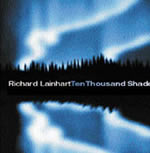
Artist: Richard Lainhart Album: Ten Thousand Shades Of Blue Label: XI Review date: Mar. 31, 2002 |
|
|
|
|
The great paradigm shift in 20th century western music was the revelation that time and movement in composition could be freed from Pythagorean and mechanistic templates.
The seeds for this new growth were scattered in winds from Asian and Indonesian musical traditions, planted in new ground near the turn of the century by pioneers like Debussy and Satie. This fertile ground was mapped later by visionary composers like Webern, Cage, Feldman, Stockhausen, and Lamonte Young, each of whom produced compelling cartographies of their individual, but somehow related, sound worlds.
Richard Lainhart comes from a later generation of explorers. The works collected here are from the 70s and 80s, the height of the vogue for minimalist composition. But Lainhart’s work from that era moves in a different circle from the pulse and phase repetition of Riley, Glass, and Reich: Lainhart finds his patterns in the processes of nature; his repetitions are analog to the floating, drifting, and slowly shifting patterns of waves, winds, cloud formations. The pieces on this collection are arranged in chronological order, and we hear Lainhart’s art develop from early contemplative non-linear tone sculptures for bowed tam-tams, temple bells, and tapes to later pieces for mallet instruments and electronic processing that ripple and undulate, generating slow and subtle waves of emotion that ultimately catch the listener by surprise. Lainhart’s work evinces comparison to some of Pauline Oliveros’s Deep Listening music, in that it seems to surround the listener gently, then draw out emotion through a sort of entrainment effect. This is music that is very quiet and very powerful.
More than anything else, Richard Lainhart’s sonic constructions inhabit a place where mystery and ambiguity resonate with untranslatable meaning through process and perception.
By Kevin Macneil Brown
|





 View all articles by Kevin Macneil Brown