|
|
 |
Dusted Reviews
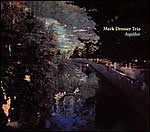
Artist: Mark Dresser Trio Album: Aquifer Label: Cryptogramophone Review date: Mar. 31, 2002 |
|
|
|
|
I’m sure plenty of avant-jazz records have been made with the flute/piano/bass line-up, but offhand I can’t think of any, and maybe there's a reason for that, besides the practical one that most jazz flautists also play sax. Bass, piano and flute are almost comically different from one another in a number of important ways, such as range, timbre, and attack (the initial sound heard when a note is played). Although it’s reductionist, a useful criterion for judging Mark Dresser's new Aquifer might be the following: A successful flute-piano-bass record necessitates either a unique approach to orchestration or a willingness to present the differences among the instruments in a humorous way.
Aquifer isn't overtly humorous, so the first part of the criterion is the more relevant one here. If Dresser was thinking as much about orchestration as I am, he could hardly have picked better players: Ziegler coaxes a surprising array of sounds from a wide variety of traditional and nontraditional flutes, and Maroney is capable of unbelievably bizarre and eerie noises at the piano. Dresser, who's played with Tim Berne, Anthony Davis and most famously in Anthony Braxton's '80s quartet with Marilyn Crispell and Gerry Hemingway, is himself a fantastic bassist who's mastered the extended technique of his instrument by way of free jazz and the postwar avant-garde.
Unfortunately, on a few tracks, the musicians assume their instruments' typical roles. The playing is uniformly excellent and the melodic lines are spindly and surprising, and conventional swinging isn't necessarily a bad thing when it's done as well as it is here. But it's hard to get past the unusual line-up: the flute sounds a bit too graceful atop the waddling thump of the bass. Maroney tries to negotiate between the two, but the sound of a traditionally played piano is so different from either instrument that it feels like he's not speaking their dialect.
More successful-- and far more frequent-- are the tracks where the musicians stretch the boundaries of their instruments so far it's hard to tell who's playing what. The calisthenics are displayed brilliantly on the album's ghostly centerpiece, "Sonomatopoeia". Here, Ziegler plays weird staccato thwaps and otherworldly alto- and bass flute lines; Maroney's piano sounds first like a high-pitched harp, then like the clangs of a sheet-metal factory; and Dresser plays high-pitched plucks that sound like Derek Bailey's guitar, then bows rough lines that sound like the groans of a seasick old man. The music is evocative, even cinematic, and the textures—if not the individual notes—seem tightly scripted. This style of jazz probably leaves too little to chance for some improvisers, but there’s plenty of fertile ground here, and Dresser is plowing a space of his own.
By Charlie Wilmoth
|




 View all articles by Charlie Wilmoth