




|
|
|
|
|
|
|
|
|
|
||||||
| |||||
|
|
||||||||||||||||||||||||||||||||||||||||||
|
|
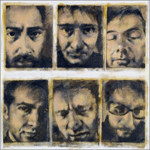
Bittersweet Symphonies"My hands 'round your throat, if I kill you now, well, they'll never know." Thus begins Waiting for the Moon, with another world-weary ballad cloaked in mournful strings. We're on familiarly bleak and gloomy (although not entirely unironic) Tindersticks ground here and, in the case of this band, familiarity certainly doesn't breed contempt.
There's little room for ambivalence when it comes to Stuart Staples and Co. Like the diverse artists from whom they draw inspiration (e.g., Leonard Cohen, Scott Walker, Ian Curtis, Serge Gainsbourg, Nick Cave, and Tom Waits), you love them or you have no time for them. You either find the band's small-hours balladry absolutely riveting and want them to keep making unhurried chamber-pop symphonies of ennui, heartache, and general melancholy ad infinitum, or you think they're a bunch of tiresome, self-indulgent miserablists who really ought to get a life.
2001's Can Our Love… saw Tindersticks stumble out of that smoky lounge where they doubtless spend all of their time languishing and brooding, and venture into the dark night of '70s soul, with the likes of Curtis Mayfield, Bobby Womack, and Al Green as their guiding lights. The rich strings and do-do-do backing vocals on new tracks like "Trying to Find a Home" show that Tindersticks have still got soul. This time around, however, that influence isn't quite as pronounced; instead it's worked into the broader idiom of their orchestrated baroque pop.
Dickon Hinchliffe's melancholy string arrangements are as stirring and evocative as ever, fruity Hammond and a liquid Fender Rhodes occasionally bubble just beneath the surface, and subtle angelic backing vocals often hover above Staples' lush baritone. While the delicate, lilting "Sweet Memory" and the sweeping, cinematic "My Oblivion" are signature Tindersticks melodramas, in places Waiting for the Moon also has a slightly harsher edge – something that's not without precedent in their work.
The more stark "Say Goodbye to the City," for instance, has an anxious, urgent feel thanks to its syncopated rhythms, woozy, hypnotic viola, and momentary bursts of squalling brass, which evoke some of Spiritualized's more frenzied moments.
That rawer edge is further explored on one of the album's highlights, the Velvet Underground-esque "4.48 Psychosis," a dark, spoken number in the same vein as their earlier song "My Sister" (albeit without a shred of irony or gallows humor). Over tense layers of droning, abrasive guitars, sawing strings, and a relentless beat, Staples speaks lyrics culled from the play 4.48 Psychosis by British dramatist Sarah Kane. Set in a mental hospital, the play is named after the dawn moment when people are apparently at their most lucid and, consequently, most likely to commit suicide. Kane committed suicide in February 1999, aged 28.
In marked contrast, the other standout, "Sometimes It Hurts," is a playful, slightly camp boy-girl dialogue. Stuart Staples is no stranger to duets, having teamed up with a range of female vocalists over the years, including Ann Magnuson (Bongwater), Carla Torgerson (the Walkabouts), and actress Isabella Rossellini. On this theatrical number, he's at his baritone-mumbling best, suffering the reproaches of breathy French-Canadian songstress Lhasa de Sela.
Quite often, when a band is criticized for being repetitive, for just doing one thing, at the bottom of that criticism is a sense that their songwriting is one-dimensional – that their basic idea, whatever it may be, simply isn't good enough to hold up to being endlessly reproduced. Tindersticks' songwriting, on the other hand, seems timeless; it has considerable depth and multiple dimensions to it. So I have no complaints that they keep on doing pretty much the same thing. By Wilson Neate
|
||||||||||||||||||||||||||||||||||||||||
|
||||||||||||||||||||||||||||||||||||||||||
| |||||


 Trouble Everyday