|
|
 |
Dusted Reviews
Artist: Yasunao Tone Album: Yasunao Tone Label: Asphodel Review date: Jun. 17, 2003 |
|
|
|
|
Eastern Tones
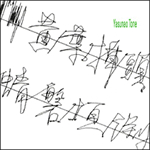
In his liner notes, Yasunao Tone informs the discerning reader that his work is in severe dialogue with Lacan, information theory, Slavoj Zizek, Lyotard, Saussure; in other words, all the general 20th century intellectualism fit to print. While taking time to digest the linguistic complexities at stake, the listener is treated to about 53 minutes of sculpted noise in which the recorded waveforms of a skipping CD sample source are contoured according to Chinese symbols derived from Man’yo-shu, an 8th century poetry anthology.
With a project of such sizable magnitude and intricacy, it seems reasonable to think Tone’s strong work and legendary status will finally be greeted with some long-deserved acclaim and critical awareness.
Granted, the past decade has shown numerous attempts at giving Tone due credit. Releases on both Lovely and Tzadik have shown Tone’s indispensable value in avant-garde music history, linking him both with Robert Ashley and John Zorn, respectively. Yet, with this release on Asphodel and some previous work with Florian Hecker (of Mego fame), Tone comes across as perhaps one of the most forward-looking, most contemporary artists to emerge from the fertile Fluxus movement, someone very engaged with their work and still thirsty for understanding.
The Fluxus affiliation is very pertinent, but after four decades seems to have faded slightly underneath the intellectualism of Tone’s current predilections. In one of the circulating manifestos from the time, Fluxus catalyst George Maciunas posed that the movement’s aims should be to “promote non art reality”. Like most manifestos, the actual meaning, or “non art reality” of “non art reality”, is vague at best, yet Tone’s difficult liner notes seem to suggest he fits in here, in the quest for the “real” (it seems the more you talk about these things, the more parentheses and quotations surface).
Tone talks about musical notation as symbolic representation, his substitution of Chinese figures to serve as a notation, which are already symbolic representations in and of themselves. Going further, Tone makes an example of Lacan, quoting, “In a dream, Choang-tsu is a butterfly. When Choang-tsu wakes up, he may ask whether it is not the butterfly who dreams that he is Choang-tsu.” Oh, the koan-like nature of French thought! When Choang-tsu wakes up, maybe he is dreaming of a butterfly dreaming he is Choang-Tsu, or maybe he is a butterfly dreaming he is Choang-Tsu dreaming of a butterfly dreaming of Choang-Tsu. I hate to be as uneducated to toss off critical theory, but it seems to embody the very conflicts it tries to transcend.
This still leaves something to be desired in the translation of Tone’s work. What does it actually mean? To preach about the surprising aesthetics of the release seems to miss the point. The listener is left in the dark with a CD of the sounds of a skipping CD, violently panning, bursting in each speaker, and decidedly engaging. Prickly and chaotic, it’s frustrating to think Tone’s has shed the populist pretenses of Fluxus (although, you should try and name one of those artists who didn’t!) and made work so academically unassailable. Importantly, though, especially for those interested in music for the sound of it, there is no monotony here. Tone truly utilizes one of the most distinctive and diverse palettes in electronic noise, and this release is the most developed in that regard. It just seems impossible to separate the curious, beautifully strident music from the indecipherable and perplexing thoughts behind it, especially with a wonderful subject like ancient Chinese poetry looming in the background of the work.
By Matt Wellins
|





 View all articles by Matt Wellins