|
|
 |
Dusted Reviews
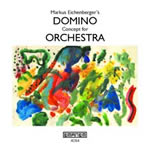
Artist: Markus Eichenberger Album: Domino Concept for Orchestra Label: Emanem Review date: May. 13, 2003 |
|
|
|
|
Via Negativa
The London-based Emanem label hardly ever releases recordings not produced primarily by British improvisers. So you know that Martin Davidson must find something special indeed on the rare exceptions. Technically speaking, Eichenberger and his mostly Swiss colleagues are running a game-piece here, or, in other words, working through structured improvisations. In addition to the leader (who plays clarinets), the group consists of vocalists Marianne Schuppe and Dorothea Schürch, trumpeter Carlos Baumann, fabulous trombonist Paul Hubweber (also on Emanem’s recent Papajo), tubaist Carl Ludwig Hübsch, saxophonist Dirk Marwedel, violinist Helmut Bieler-Wendt, violist Charlotte Hug (whose recent Emanem solo recording Neuland is essential listening), bassists Peter K. Frey and Daniel Studer, guitarist Frank Rühl, and percussionist Ivano Torre.
This baker’s dozen doesn’t employ the semi-familiar methods of either John Zorn (with their channel-surfing excess) or Lawrence “Butch” Morris (who has mastered the art of conduction). Rather, the large ensemble works with silence and meditative calmness (what the liner notes call “impulse and control”). Eichenberger marks changes of direction, which shape the interplay of impulse and control, solely by switching from one type of clarinet to another (he plays five of them, and is particularly effective blending his contrabass clarinet with tuba and vocals).
Of course, it’s old news that much European improvisation is now more concerned with texture and silence than with hard blowing. Twenty years ago a band of thirteen might have focused all their energy on generating enough wind and heat to blow the walls off the studio, but (fortunately, perhaps) that moment has largely passed. The Domino Orchestra is a listening band, and excess is deftly circumvented throughout this hour-long performance. Saxophones playing extended techniques, along with clarinets, mewl amidst burbling brass, shards of guitar, agonistic vocals, and scraped strings and percussion. Thankfully, though, it’s not simply an endless slew of textures (a sad outcome of some post-free jazz ensemble improvisation – restraint is one thing, but you’ve still got to go somewhere). There are sudden left turns (the thudding tattoo and brass of "Part II," for example, or the symphony of chirps heard later in the piece) and changes of direction which keep the music playfully unsettled. Just when the orchestra seems ready to launch into tutti squealing, they pull back into the gentlest of drones over which the vocalists mutter incantations. Only in the closing sections is any real heat generated, but it actually means something given the restraint the ensemble admirably displays elsewhere.
Stripped-down, this neo-chamber ensemble takes the via negativa, communicating powerfully through what they leave out while leaving the listener to connect the dots between their subtle gestures, cryptic asides, and compelling allusions. What the Domino Orchestra lacks in hard-charging individualism, it repays in subtle, provocative group playing.
By Jason Bivins
|




 View all articles by Jason Bivins