



|
|
|
|
|
|
|
|
|
|
||||||
| |||||
|
|
||||||||||||||||||||||||||||||||||||||||||
|
|
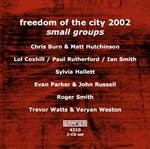
Live British Free ImprovFreedom Of The City 2002: Small Groups, recorded live in London last May, offers mostly convincing evidence for the health of the mainstream of British free improvisation in general and of the Emanem label in particular. There’s very little that unifies the music on this sprawling double-disc set, other than that most of it seems to be freely improvised, and much of it is scrambling and busy rather than fiery.
Trevor Watts and Veryan Weston begin the first disc. In contrast with most sax/piano duos, Watts and Weston balance nicely with one another, with Weston sticking mostly to single-note lines and thinly voiced chords. Weston’s piano playing, therefore, doesn’t overwhelm Watts’ saxophone or force the duo’s partnership into a boring melody-and-accompaniment straightjacket. Watts’ superb playing begins with the sort of tapered-off phrasing and singing vibrato one might expect to hear on a blues record, but his syntax and note choices are wonderfully odd.
Sylvia Hallett is certainly the odd person out here: her set is based on looping digital delays and changing textures rather than real-time improvisation. Hallett’s abilities with loops and many acoustic instruments are impressive, but I suspect that her eerie, evocative pieces would sound better if they were recorded in a studio, where she could take advantage of the intimate production upon which her style of (semi-) electronic music often depends.
Soprano saxophonist Lol Coxhill, trumpeter Ian Smith and saxophonist Paul Rutherford end the first disc with two trios that switch seamlessly between traditionally played notes and extended-technique growls, spits and screeches. The three players stay at roughly the same dynamic level throughout each piece (although the second piece is far quieter than the first), but they’re always listening to each other, constantly changing textures.
After fourteen minutes of Roger Smith’s tangled, Derek Bailey-esque solo guitar, Chris Burn and Matt Hutchinson offer two duos featuring two very different instruments. Burn, especially, is a fascinating player, but his trumpet never sounds like anything but a trumpet. Hutchinson’s electronics, meanwhile, are a reminder of what electronics sounded like in 1983. With live improvisation, it’s not fair to expect electronics to be as crisp as they are in studio recordings, but here there’s a huge difference in sound between the two instruments. In this exposed setting, the two players might have been better served by trying to sound a bit more like one another.
Soprano saxophonist Evan Parker and guitarist John Russell finish off the second disc. Parker’s rapid-fire circular breathing tends to leave some of his collaborators in the dust, but Russell sticks with him nicely by looking for the moments where Parker really gets going, poking him with accelerating plucks and busy chord patterns that propel him forward. By Charlie Wilmoth
|
||||||||||||||||||||||||||||||||||||||||
|
||||||||||||||||||||||||||||||||||||||||||
| |||||


 View all articles by Charlie Wilmoth