|
|
 |
Dusted Reviews
Artist: Bonnie 'Prince' Billy Album: Master and Everyone Label: Drag City Review date: Jan. 15, 2003 |
|
|
|
|
Servant of All, Servant to None
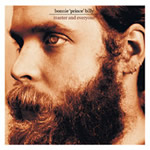
Will Oldham’s face stretches across the entire cover of his new album. He wears a full beard, and were it not for his three earrings he would be a dead ringer for a 19th century prospector or a Russian novelist. His eyes are glazed and burn like a sun as they stare blankly, yet with a mysteriously furious intent. It’s a cinematically striking image that captures every bit of the sorrow, frustration and passion contained within the album that it adorns. You could spend an hour staring at him, picking his brain, sympathizing with his unmoving sorrow, but only once the album begins does it become clear that Oldham’s photographic despondency only scrapes the surface of musical heartache contained within. Like the cover, musically it’s Oldham’s most spare, straight-forward and unobstructed album to date; deceptively simple and achingly sad.
Master and Everyone, Oldham’s third full-length album under the Bonnie ‘Prince’ Billy moniker, is a darker exploration of humanity even than his death-comes-creeping masterpiece, I See a Darkness, and more lucid than 2001’s relationship tribute, Ease Down the Road. Master and Everyone picks apart the ending of Oldham’s relationship in a perverse and probably unintentional coalescence of these themes. Not only is it the strongest of the three, it is perhaps Oldham’s best work yet, and somewhat ironically, his most accessible as well.
Master and Everyone's guiding sentiment is laid out in its first line (on “The Way”) as Oldham gently sings: “Winter comes and snow / I can’t marry you, you know / Without children to grow / I can’t marry you, you know.” It continues through the last song, “Hard Life,” which begins with Oldham crying: “It’s a hard life / For a man with no wife.” That the decision to abandon his relationship seems to be of his own pained accord is vital to the album’s tone, as Oldham wrestles with the fact that he still loves his ex-girlfriend. Indeed, “The Way” continues to the chorus as Oldham begs: “Love me the way I love you.” The strings that accompany this line make for the most instrumentally lush moment of the entire album, most of which is comprised of guitar, vocals, and simple one-note-per-measure bass. Guitar solos are few, and they sound nearly as pained as the vocals, trailing off into silence.
Oldham’s voice is just above a whisper throughout and lacks any of the wail, yelp, or other dissonance that he frequently exhibits; by weakening his vocals he strengthens their force. On the chorus of “Master and Everyone” he coos in a delicate falsetto. On “Wolf Among Wolves” he strains to reach the highest note, howling softly without raising his voice, and then returning to a whisper. He is occasionally joined by a female vocalist who mimics his vocals, and whose precise and gentle voice complements Oldham’s nicely, serving as a tonal and contextual companion. The overall emptiness of the recording is striking. Every audible sound becomes vital, especially upon repeated listening: On such a bare canvas as this, a light foot tap, the shuffling of a chair, or a loud intake of breath can become a momentary focal point. Nothing is accidental nor is anything gimmicky. He uses the word “love” on nearly every song, pronouncing it slightly differently each time. Sometimes it’s a terse, single-syllabled “luv,” sometimes a lengthy, forlorn “luuuuv,” and sometimes a slurred, trailing-off “luuuhf...”
His mastery of inflection is matched and exceeded by his manipulation of language. On “Hard Life” Oldham alternates between referring to “a hard life” as something that “God lets you live” and something that “God makes you live.” Throughout the album he never fully lets on which is actually the case, but even by the very end either one sounds equally plausible and equally painful. On “Joy and Jubilee,” the despondent Oldham sighs: “There’s no reason to be seen / No one knows where I have been / Where I have been / I mean love is what I mean.” He frustrates coherence, but does so with astonishing clarity, continuing to the chorus in morose melody as he repeats the phrase “Joy, joy and jubilee.”
The album’s centerpiece -- and one of the best songs that Oldham has ever recorded -- is the title track, “Master and Everyone.” Here Oldham fights a bitter battle against his own feelings and instincts as his monologued argument drifts from an I don’t like you frustration into an I don’t need you relief, neither of which feel fully sincere. His opening proclamation: “You tell me you don’t love me / Well I don’t love you. / You say that you don’t want me / Well I don’t want you,” is scornfully juvenile and tragically untrue. The mid-song chorus eases off, but continues with the theme as Oldham sings: “You do what you want / And I will do what I want / I’m now free / The master and everyone / Servant of all and servant to none.” But by the end he claims to embrace the illusion of freedom, proclaiming “I’m like a bird freed from its cage / All night and all day I’ll play then sing.” It’s neat metaphor, taken in or out of its context, and maintains the image of Oldham naively claiming to enjoy the relief of his loss. Rarely has the thought of a frolicking songbird seemed quite so morose, and rarely has Oldham seemed so completely lost.
On Master and Everyone Oldham creates himself as a character that is as conflicted and as well-developed as any fiction writer could hope to think up. He is conflicted and sympathetic, but has enough depth that he is not entirely predictable. While his thematic focus is narrow, his exposure is vast. The entire package – the music, the recording, the cover, and the words – is completely seamless and impressively complete. Whether or not this marks the end of Oldham’s Bonnie ‘Prince’ Billy era, it will certainly stand as a high point in an already phenomenal career.
By Sam Hunt
|





 Sings Greatest Palace Music