




|
|
|
|
|
|
|
|
|
|
||||||
| |||||
|
|
||||||||||||||||||||||||||||||||||||||||||
|
|
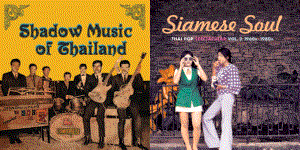
What might strike you first about Sublime Frequencies’ two recent releases from Thailand is how western they sound – organ riffs, funk guitar, and fill-happy, hand-played drums straight from psychedelic central casting, wrapped in characteristic late-British Invasion moodiness.
Roong Petch Laem Sing - "Kob Kanong Fon"
One of the releases, Shadow Music of Thailand, actually anthologizes an entire genre named after one British band, Cliff Richard and the Shadows. The awesomely-named handful of bands featured on it (Son of P.M., Johnny Guitar, P.M.7/Jupiter, and P.M. Pocket Music) play short, charming garage rock instrumentals.
Johnny Guitar - "Mon Du Dow"
Were Thai kids in the 1960s and ’70s so bowled over by Doors and Incredible String Band imports that they laid down their ancestors’ instruments and started weird rock bands? (Thought experiment: Would that be sad?)
Thailand was never, technically speaking, colonized. However, it was an important military station during the Cold War and Indochinese engagement, and for decades took its political cues from other countries, the United States and China in particular. Siamese politicians were effectively coerced into policy positions by superpowers with strategic regional interests. On multiple occasions, the U.S. dangled generous packages of international assistance, delivering only when they felt satisfied that the military was taking a hard line against domestic communism. In an all-too-familiar game of realpolitik, regimes were propped up or starved on ideological whims. And underscoring the geopolitical importance of Thailand during the period – as well as the extent of its compliance – an estimated 85 percent of air strikes by the U.S. during the Vietnam War were launched from bases in northern Thailand.
Thai culture had everything to do with the political situation in those years. First, as part of a general strategy of synchrony with the west in the 20th century, Thailand sought to modernize rapidly. Ritualistic, local practices were discouraged and in some cases even criminalized. (See The Overture for a slightly cheeseball dramatization of how this affected traditional music in the 1940s.) Licenses were instituted for the performance of old-fashioned instruments. From food to music, clothing to religion, medicine to language, the political elite intended to bring every part of the country up to a more modern speed, by force if necessary.
Second, the de facto transformation of Thailand into a military base ignited a thriving tourist economy. With hundreds of thousands of soldiers passing through, local entrepreneurs built hotels, neon brothels (and more neon brothels), and shops catering to international clientele. Even metropolitan Bangkok had been substantially agrarian until then, but after the war it attracted significant investment and a number of international architects. (One of the city’s first skyscrapers, perhaps not surprisingly, served as a regional office for the CIA.) And cosmopolitan spaces, of course, are made for cosmopolitan people, of whom Bangkok very quickly had no shortage.
Sublime Frequencies is a minimalist label. They tell you very little about the music on offer, and in fact it was interesting to see that Siamese Soul: Thai Pop Spectacular Vol. 2: 1960s – 1980s and Shadow Music of Thailand even had artist and track listings. Earlier releases by the label were silent altogether, conveying above all else the ecstatic imbalance of foreign travel. Credit to the label for acknowledging the musicians this time around.
And yet, the cosmopolitan kids in the photographs here pose distantly, the luuk chaay le luuk sao of Marx and Coca-Cola. Like many Thais – like many people anywhere – they seem to be disavowing the subject of politics altogether, even if they get it. If they are looking to the west with their musical choices, as their self-conscious glances seem to suggest, their preferences can only come out of that blackest of black boxes: taste. No one is making them do anything. If this is in fact their conceit, Sublime Frequencies does not contradict it. By Ben Tausig
|
||||||||||||||||||||||||||||||||||||||||
|
||||||||||||||||||||||||||||||||||||||||||
| |||||


 View all articles by Ben Tausig