|
|
 |
Dusted Reviews
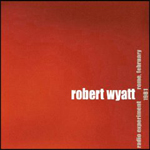
Artist: Robert Wyatt Album: Radio Experiment Rome, February 1981 Label: Rai Trade Review date: Aug. 13, 2009 |
|
|
|
|
Free improvisers aside, musicians usually strive towards something that conforms to some notion of getting it right. No matter whether you’re Steely Dan, the A-Frames, or the Chicago Symphony Orchestra, you’re working toward a best take, a right sound, a finished product. Robert Wyatt banished such notions from his mind before he rolled into Italian Radio 3’s studio on February 18, 1981. He’d been asked to reveal his working process to Un Certo Discorso, and took the invitation at its word. He started improvising in the studio, testing out the gear and seeing what ideas came to mind; he didn’t even ask the engineers to roll tape for three days, although the nervous producers eventually started doing so surreptitiously.
Although it was broadcast at the time, Radio Experiment Rome, February 1981 hasn’t been widely and legally heard until now. Since Wyatt’s recording career is strewn with gaps and startling turns, any new documentation is appreciated, but this does more than fill in a gap. First, it bridges the gap between Wyatt’s mid-1970s jazzy prog phase and the politicized pop he pursued during his sojourn with Rough Trade records. Second, it gives a glimpse of Wyatt the studio experimentalist in his element.
Mind you, aside from the installation and LP side-long recordings he made with Soft Machine, Wyatt has never made anything you could really lump into the meaningless category of “experimental music.” Even at its most eccentric, Wyatt’s music doesn’t try to sound weird or try to articulate some grand concept. The big ideas articulated in Wyatt’s music — justice, ethics, politics, and friendship — all have to do with human relationships. While there was something implicitly political in his inclusion of Charlie Haden’s “Song For Ché” or his choice to record with the South African trumpeter Mongezi Feza, the point became much more explicit on the Rough Trade singles, which included a Chilean protest song, a Cuban anthem, and a couple sides celebrating the Russian stand against Hitler at Stalingrad. Wyatt foregrounds such concerns from Radio Experiment Rome, February 1981’s first number. “Opium War” comes at you with a profusion of voices, sung, recited, sped-up, looped. The interwoven texts contrast a Mao-ist analysis of the conflict in question with staid BBC narration of more recent military misadventures in China, while snaky synth and sung lines twist in and out of the onslaught of information. Title aside, “Heathens Have No Souls” is wordless, all the better to hear how the piece was constructed from repeating vocal, piano and woodblock figures. Over the top Wyatt scats, smearing his voice with studio effects and a Jew’s harp, building to a frenzy that sounds like a goof on Indian vocalized percussion.
For Wyatt, experimentation is an essential aspect of the creative process, but nothing fancy; he gets an idea, he tries it out, and if it works he uses it. And that’s what he did during this session. “Revolution Without “R”” renders the process transparent. Singing over a drum loop that sounds like something De La Soul would use a decade down the road, Wyatt tries out lyrical ideas and vocal deliveries, then analyzes the results. “That’s not a very nice song,” he apologizes. “Let’s sing another song.” For more naked experimentation, there’s “Prove Sparse” (Italian for “Scattered Rehearsals”), a string of fragments snatched from the session’s first three days. It is truly more scattered than the songs that precede it on the CD, but handy to hear how he gets from the tabula rasa situation of being let into a studio with no prepared material to the sometimes whimsical, sometimes sublime songs that he laid down during the session’s last two days. Only one of these tunes, “Born Again Cretin,” made it in a re-recorded and considerably sanded-down version to Wyatt’s next album Nothing Can Stop Us, but that hardly means that the experiment was a failure. Its exposure of his process was enough; this swell record, which circulates the results beyond Italian radio listeners and tape traders, is already gravy.
By Bill Meyer
|




 Solar Flares Burn For You