|
|
 |
Dusted Reviews
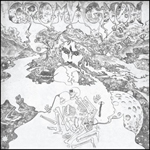
Artist: Cromagnon Album: Cave Rock Label: ESP-Disk Review date: Jun. 29, 2009 |
|
|
|
|
Originally released in 1969 (as Orgasm), Cromagnon’s first and only full-length is intriguing and utterly confounding, a jumble of rackety percussion, chants, shouts, moans, giggles, whispers, drones, found sounds, bizarre rituals, ethno-freak-outs and one actual song, “Caledonia,” a sort of metal bagpipe reel. Its two main songwriters, Austin Grasmere and Brian Eliot, were, by all accounts, bumping hard against the limits of writing bubblegum pop for money. They heard somehow about the eccentric ESP-Disk label and dropped in to its studios for one day to record this odd, possibly brilliant, but only marginally listenable CD. The album went on through the ’70s, ’80s and early ’90s to become a kind of lost Atlantis type of recording, heard about more often than heard, an entry on Stephen Stapleton’s famous list. It was released on CD for the first time in 1993, again in 2000, once more in 2005 and this time, possibly prodded by Ghost’s cover of “Caledonia” two years ago, in 2009. It is always released by the original label, ESP-Disk, and the critical reaction always seems to be the same: How could anything this weird, this prefigurative of industrial out-rock and experimental psyche have possibly been produced in 1969?
Certainly, you can listen a long time without hearing much overt reference to the 1960s. There’s a jangly, campfire-ish guitar at the foundation of “Crow of the Black Tree,” though it’s mostly obscured by wild group shrieks and moans, women and men together, though not exactly in unison. Scrubbed and well-behaved 1960s radio-jingle harmonies kick off “Fantasy,” but it doesn’t take long for the cut to dissolve into maniacal cackles and an altered voice careening through Doppler-altered non-linear observations (“I’m bleeding.” “Having died there…”). The tone is both stone-aged and futuristic, sirens cut through with stray radio broadcasts, tribal celebrations framed by electronic squiggles and blasts. “Caledonia,” by a huge margin the most accessible cut on the disc, thunders with drums, whines with bagpipes. Other bands of the era – Pentangle, Fairport Convention, etc. – were working with updated takes on Celtic folk, of course, but none of them were adding this kind of harsh, over-amplified vocals.
In fact, most of the bands that Cromagnon recalls – Faust, Throbbing Gristle, Nurse with Wound, etc. – didn’t exist in 1969. The band’s total disregard for melody, structure, narrative or time signature is shockingly modern not just for 1969, but even now. “Ritual Feast of the Libido” tests the listener with an extended barrage of really unpleasant, unmusical sounds – a whip-beat, and a man howling in either pain or pleasure. “Organic Sundown,” where members of the “Tribe” credited on the album trade whispers, yelps, hisses and intonations of the word “Sleep,” rides a ramshackle percussive rhythm that could be NNCK or Sun City Girls.
It is not easy to listen to Cave Rock all the way through, and even if you find it interesting, you may not be able to muster any real affection for these difficult tracks. There’s a palpable fog of self-indulgence hanging over the whole enterprise, a sense of weirdness for weirdness’ sake and lack of discipline or structure. Still, there’s no question that Cromagnon achieved something remarkable in its strange concoction of noise, spoken word, folk, electronics and field recordings. It’s worth remembering that the top four songs of 1969 were the Beatles’ “Get Back,” the Rolling Stones’ “Honky Tonk Woman,” Zager and Evans’ “In the Year 2525,” and the Archies’ “Sugar Sugar.” Nobody was doing anything remotely like this, and certainly not in Connecticut.
By Jennifer Kelly
|





 View all articles by Jennifer Kelly