|
|
 |
Dusted Reviews
Artist: Group Doueh Album: Treeg Salaam Label: Sublime Frequencies Review date: Jun. 1, 2009 |
|
|
|
|
Western Sahara’s story is a sad but typical one for a post-colonial land with bigger, stronger neighbors. In the ’70s, a nearly century-long episode of Spanish occupation gave way to bruising jockeying for possession between Morocco (which currently holds sway), Mauritania, and the homegrown Polisario movement of nationalist liberation. Episodes of war have generated a civilian diaspora that’s spread from refugee camps in neighboring countries to Cuba, but life for the people who have stayed behind carries on like it does anywhere. Folks still like to marry and party, and if they do so in the coastal city of Dakhla, they’re likely to hire Group Doueh to bring the tunes.
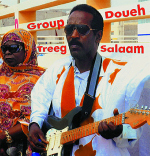
The group is part of a family entertainment business run by Doueh, a Dakhla native whose birth name was Salmou Baamar. As a youth, he took a shine to the sounds of James Brown and Jimi Hendrix, which he heard on cassettes imported from Spain. His first experiences as a professional musician playing at local parties coincided with Mauritania’s occupation of Dakhla, and you can hear both Western rock sounds and Mauritanian rhythms in his music, which he’s been performing throughout the region and marketing on cassette for over a quarter century. Doueh plays the tinidit (a.k.a. tidinit), a Moorish four-stringed lute, and electric guitar; according to a recent Wire article, he favors a Fender run through a few pedals. The rest of the group includes vocalists Bashiri Touballi and Halima Jakani (his wife) and keyboardist Jamaal Baamar (his son). Rhythm duties are shared between collective handclaps, Halima’s tbal (a hand drum), and the keyboard’s drum programs.
When they aren’t playing at local festivals and weddings, Doueh runs a cassette dubbing shop, and that’s where Sublime Frequencies’ Hisham Mayet located him after a search up and down Morocco to find the musician responsible for “Eid For Dakhla,” the raucous, backbeat-heavy ruckus that opens Doueh’s first LP Guitar Music From the Western Sahara. That record also kicked off Sublime Frequencies’ series of vinyl-first releases of contemporary guitar music heard around the Maghreb. Although Group Doueh’s music enjoys the same no-budget recording quality as the rest of the series, it differs significantly from the Touareg-rooted approaches of Group Inerane and Group Bombino. The music of the desert interior sounds like the blues, sometimes jacked up to rock distortion and intensity; Doueh’s has a more complex rhythmic underpinning, closer to the Master Musicians of Jajouka or flamenco, and adheres to traditional Mauritanian modes that spin the melodies down different paths than those of their deep Saharan brethren, more elaborate but less open-ended.
This spring the Sublime Frequencies put together a European tour for Group Doueh and labelmate Omar Souleyman, which occasioned the release of Treeg Salaam, which like its predecessor was culled from Doueh’s massive cassette archive. Mayet selected music recorded between 1989-1996, which makes some of it significantly older than the mostly recent material on the first LP, but without annotation, there’s no sense of artistic evolution. Instead, what comes across is the impression that this band puts on one hell of a party. The shorter tracks on side A move at a frantic pace, with twinned vocals skywriting melismatic trails over pounding, unevenly accented beats; in the background, you can hear the ladies screaming and ululating their appreciation. Doueh’s buzzing, heavily phased guitar sound is the glue that holds it all together. He’s an elastic presence on “Min Binat Omun,” bouncing between funk-like fills and boingy, wahwah-laden leads; on “Beatte Harab” the guitar skirls and drones almost bagpipe-like, weaving in and out of the vocal lines. Flip the record over and you’re probably closer to what Group Doueh would sound like if you booked them now. “Tazit Kalifa” is a sidelong performance that is more varied and dynamic than anything else Doueh has let out of Western Sahara. Jamal’s keyboard, set to a churchy organ voice, is a dominant voice, and his relentless rhythm machine isn’t far behind. Doueh’s electric guitar spars with an acoustic tinidit, and both trade licks with the spiraling organ. Beats come in and out of the mix, giving release from the tension generated by long solo groove-less passages where Bashiri sings over repetitive keyboard riffs.
Treeg Salaam, which translates as “Streets of Peace,” does everything you would want from the follow-up to a successful introductory effort. It gives you a bit more of the raw immediacy and worlds-colliding style that Guitar Music From The Western Sahara served up so well, but shows additional aspects of Group Doueh’s music. It suffers from the same flaw; on “Ragsa Jaguar” the recording quality lapses into distortion so shrill that only a no-fi fetishist could love it. Even so, it’s a vivid document. Be aware that Sublime Frequencies has sprung for a pressing of 1500 instead of 1000 this time, so it’ll probably take an extra couple weeks to sell out. But if past performance is anything to go by, the LP probably won’t be around for long.
By Bill Meyer
|





 Beatte Harab