|
|
 |
Dusted Reviews
Artist: Zach Wallace Album: Glass Armonica Label: Root Strata Review date: May. 19, 2009 |
|
|
|
|
In its two hundred year history, the glass armonica has played many roles. It was a serious attempt by Benjamin Franklin to create a new instrument for the classical repertoire; believed to cause insanity in its players, it gained traction as an object of superstition; a century or more in historical obscurity ensued, followed by its revival as a compositional curiosity for a handful of composers and as an exotic timbre in soundtracks and on pop records. More recently, Christina Kubisch subtly deconstructed it, conceptually as well as sonically, on her 2006 release, Armonica.
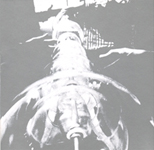
With Zach Wallace’s Glass Armonica, the instrument has come full circle, returned to its place as a brilliant example of homespun invention and potentially rich source of music. Wallace built his version instrument himself out of second-hand parts, including thrift store wine glasses, enlarging on Franklin’s design and making it playable by up to 12 people at once.
This back-story, along with the glass armonica’s singular sound, gives the album its unique aura, but also pushes it close to novelty territory at moments. The glass armonica has a singular sound, existing between the electronic and acoustic as well as the abstract and the mechanical. The mix of these properties can, and often does, result in a bewitching mesh of translucent, humming tones, while the audible manual rotation and friction of fingers rubbing the glasses ground the performances in a more immediate reality. The listener is reminded, in effect, of a very human presence behind these celestial tones.
Unfortunately, one’s focus rarely drifts too far from the fact that Wallace built the instrument himself and, on musical terms, from the spectral singing overtones of the rotating glass, which never moves out of a rather narrow range. The queasy, pulsing wobble of the tones, produced by the glasses’ rotation, is ever present, but feels underutilized. The final piece, the shortest of the three, would suggest how this quality could be shaped into compositions, but on the whole the extended performances lack space and dynamics, resulting at times in a claustrophobic mix. Wallace is to be admired for his physical invention, but one would hope for a bit more invention of the musical kind along with it.
By Matthew Wuethrich
|




 View all articles by Matthew Wuethrich