|
|
 |
Dusted Reviews
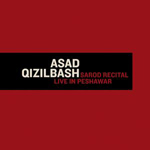
Artist: Asad Qizilbash Album: Sarod Recital: Live in Peshawar Label: Sub Rosa Review date: Apr. 29, 2009 |
|
|
|
|
The sarod’s goat skin-covered resonator gourd and gleaming, convex metal fingerboard lend it the appearance of an exotic beetle. Up to 24 strings – only a few of which are “fretted” – span the length of its squat corpus. Two unison-tuned chikari strings enable the performer to provide a chiming accompaniment; the taraf sympathetic strings resonate a ghostly chorus.
In the hands of a novice, the sarod is an unforgiving mistress. The need to produce a clear, chiming tone as well as the glissandi (meends) that characterize Hindustani classical music dictates that the strings be depressed to the fingerboard with the fingernails rather than the fingertips.
Luckily, Asad Qizilbash is a master of his craft. “Raga Darbari” starts the proceedings on a mournful note, the steel cries of the instrument offset by Qizilbash’s own rhythmic chikari punctuations and the faint buzzing of the tanpura. With Mustafa Khan’s entrance on tabla, Qizilbash’s playing becomes increasingly intense. Fast and precise runs and lyrical meends tie together reinterpretations of the melody. As one listens to the development of the raga, it’s easy to hear how John Coltrane found such inspiration in Hindustani music. The tempo picks up at about the 23-minute mark, where Qizilbash’s tremelo picking becomes even faster and more percussive but no less surgical in execution. The shorter “Raga Bihag” gets off to a statelier start, evoking something a bit sweeter than “Darbari.” The rhythm (or tala) changes its feel about midway through, rooting the by now glissandi-heavy melody in the closest we get to a groove. After an abbreviated, unaccompanied alap section, the hypnotic, skipping rhythm of “Raga Piloo” ends the program.
Pick up an instrument in Peshawar these days and you are quite literally taking your life into your hands with it. Last summer, there were music shop bombings in the ancient city with the Khyber Pass in its backyard. Qizilbash’s Sarod Recital appears like a rare flower sprouting from earth poisoned by strife. It’s a small but significant victory of the imagination over desperation.
By Adam MacGregor
|





 View all articles by Adam MacGregor