|
|
 |
Dusted Reviews
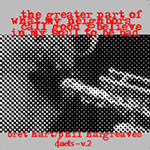
Artist: Bret Hart and Phil Hargreaves Album: The Greater Part Of What My Neighbors Call Good I Believe In My Soul To Be Bad Label: Whi Music Review date: Dec. 8, 2002 |
|
|
|
|
Lo-Fi
The Greater Part Of What My Neighbors Call Good I Believe In My Soul To Be Bad is a collection of “postal duets” from English saxophonist Phil Hargreaves, who got his start performing in punk bands, and North Carolina guitarist Bret Hart, who’s been a part of the Gajoob/Demo Universe home taping scene for decades. And while this record has much more to do with free improv than the punk and indie rock that often comes from that community, Hargreaves and Hart’s modest, home-recorded approach is a big reason for its success.
The Greater Part differs from many records of its kind in three important ways. First, it breaks the typical rules of interaction between improvisers: to construct these pieces, each of the musicians recorded several “sourcetracks,” then sent them across the ocean for the other to improvise over. Hart and Hargreaves are able to get away with this because Hart seems to have little interest in the clipped, dry guitar sounds favored by improvising guitarists from Joe Morris to Derek Bailey. Instead, he favors long, discordant drones and percussive, repetitive prepared guitar bursts, along with a variety of loops and samples. When Hargreaves plays in a more conventional Euro-improv manner (his phrasing and splattered attacks are sometimes reminiscent of a young Evan Parker), he balances Hart’s more drifting, droning approach nicely. But he’s even better on tracks like “Uglier Than Homemade Dirt,” in which he allows his playing to blend—rather than contrast—with Hart’s effects-heavy textures.
The second major difference between The Greater Part and many other free improv records is the sound quality, which is pretty bad – in the best possible way. The recording isn’t unclear enough to make the instruments hard to hear, but Hargreaves’ saxophone sounds are appealingly dry, and Hart often sounds like his microphone is about ten feet away from his amplifier. Lots of free improv records are recorded cheaply, of course, but most of those are created live, at gigs, while this one sounds like it was taped at home. The Greater Part shares its shoestring-budget intimacy with recordings by Roy Montgomery and early Space Needle, and that intimacy suits Hart’s spaced-out guitar playing nicely.
A third factor that sets Hart and Hargreaves apart is their self-deprecating sense of humor, which gives the impression that they feel they have nothing to prove, as if they’re playing mostly for themselves. In the album’s liner notes, Hargreaves mocks himself for establishing – and then failing to follow – a set of rules that would govern the recording of the album. And its song titles include “Shelf Esteem” and “the continuous adventures of mr Hugh Jass” [sic]. Sure, they’re stupid jokes, but they show how confident Hart and Hargreaves are that their music will be taken seriously.
By Charlie Wilmoth
|




 View all articles by Charlie Wilmoth