|
|
 |
Dusted Reviews
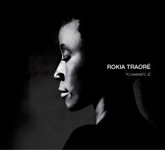
Artist: Rokia Traoré Album: Tchamantché Label: Nonesuch Review date: Mar. 10, 2009 |
|
|
|
|
Rokia Traoré has taken a somewhat circuitous route to her fourth album, Tchamantché. Born in Mali to an upper-class diplomat, she traveled the world as a child, and was raised principally in Europe. Nevertheless, when she began creating her own music (not generally something done by upper-class Bamana like herself), she reached for the instruments of the lower castes of her people, the ngoni lute of the hunter caste and the balafon (xylophone) of the jail (griot) caste. Her first albums, while hinting at a songwriter with a unique voice, fit very much with other West African musicians such as Salif Keita, Jali Musa Jawara, Oumou Sangare and Youssou N’Dour.
With her new album, Traoré strikes out in a new direction while staying true to her African roots. The atmosphere is clearly set by the first cut, “Dounia” (“World”), which begins very quietly, just Traoré’s voice and her Gretsch hollow-body electric guitar. The song builds with a little echo, a little reverb, a little feedback, and then she is joined by ngoni, solid-body electric guitar and drums as her voice grows in passion and urgency. Traoré doesn’t bugle like Angelique Kidjo (who enjoys one of the strongest voices in contemporary popular music). Rather, her sound is breathy, now warbling slightly, now gravelly, now sweet – she is, as she acknowledges, not a “traditional” African singer, but closer to an American jazz or blues singer.
The results are strikingly creative. The third cut, “Zen” (which does indeed refer to Cage’s favorite philosophy, but in French, not Bamana), is spare yet funky, gradually developing into a exciting beat that combines the three-feel/four-feel of much African popular music with the train rhythm of American blues. The instrumental approach to “Koronoko” is stylistically closer to the Wassoulou sound of Oumou Sangare, but without her sustained, microtonally inflected melismas in the voice. The song is more a showpiece for the interlocking guitars and especially the ngoni’s florid single-line melodies. The following cut, “Tounka,” on the other hand, is an ngoni-inflected rock anthem. But perhaps the most interesting song on the album is her interpretation of “The Man I Love,” a piece Traoré first performed in 2005 as a duet while touring with jazz vocalist Dianne Reeves.
In short, this is Traoré’s best work so far, and absolutely not to be missed.
By Richard Miller
|





 View all articles by Richard Miller