|
|
 |
Dusted Reviews
Artist: Cecil Taylor / William Parker / Masashi Harada Album: CT: The Dance Project Label: FMP Review date: Jan. 6, 2009 |
|
|
|
|
In the liner notes to The Dance Project, annotator Bert Noglik quotes Cecil Taylor’s declaration, “More than anything else, I have always tried to be a poet.” Best known as a pianist whose reimagining of his instrument’s possibilities was so complete and compelling that a half-century of improvising piano players who play tone clusters have inevitably had to deal with comparisons to him, Taylor has long sought a more complex integration of artistic means than simply playing music. Poetry, movement and sound all figure in his work, which seeks to engage both the intellect and the senses. This album, recorded in 1990 but only recently issued by the German FMP label, attempts to combine the three art forms, but ends up showing why Taylor is still most appreciated as a musician.
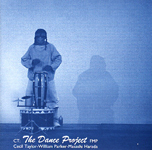
For a start, you can’t see him or the dancers. Noglik’s reminiscence of the event doesn’t really take you there, nor do the rather murky illustrations. One can only take it on faith (not a hard thing to do if you’ve ever seen Taylor perform) that the movement meant something; it may have been great, but you won’t know from the evidence of this CD.
But plenty of music for dance holds up on its own. This record fails as a listening experience in the initial “Looking Into The Universe,” where Taylor steers clear of the piano and speaks, gargles and growls to William Parker’s accompaniment. Much of the time he’s way off mike. If this record recreates the concert sound mix, no one heard a significant portion of his utterances. And if it doesn’t, they really should have tried harder to bring his voice up. Either way this track, which takes up 11 of the album’s 39 minutes, is frustratingly uncommunicative.
But once he sits down at the keyboard, things improve immensely. While it’s still hard to tell what difference the dancers might have made to what you hear, the music itself is impressive, non-standard Taylor. The difference from, say, his contemporaneous recordings with William Parker and Tony Oxley, is in part because Masashi Harada is not your average Taylor drummer. He’s gone on to combine dance and music in his own work as a conductor of large improvising ensembles, but what distinguishes his playing here is his ability to be fleet and sparing at once. He makes no effort to fill up space or impose a direction, but deftly traces and shades the pianist’s fractal sound-bodies. At times, Parker (who is now a formidable figure in his own right but was just a moderately known bassist at the time) fulfills a similar role; at others, he is a rather conservative but welcome presence, supportively adding pulse or counterpoint to Taylor’s playing. And the pianist himself leaves a bit of space, which makes it a bit easier to grasp the expanse and contraction of his determinedly non-linear music.
It’s this group dynamic that enables The Dance Project to transcend its origins and stand on its own as a flawed but worthy work.
By Bill Meyer
|





 View all articles by Bill Meyer