|
|
 |
Dusted Reviews
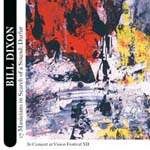
Artist: Bill Dixon Album: 17 Musicians in Search of a Sound: Darfur Label: AUM Fidelity Review date: Jun. 23, 2008 |
|
|
|
|
New music from Bill Dixon is always welcome. You don’t often hear the great trumpeter (and electronician, let’s not forget) in a large ensemble. When he’s not performing solo in the cryptosphere, Dixon is often working one of his many spectrally-inclined double-bass quartets. Aside from the now 41-year-old Intents and Purposes (desperately in need of reissuing) and a spotlight stop in Tony Oxley’s Celebration Orchestra in 1995, I can’t think of too many contexts like this one, a live document from the 2007 Vision Festival.
For this event, Dixon convened great free jazz players from multiple generations: Karen Borca (bassoon), Taylor Ho Bynum (cornet, flugelhorn), Will Connell (bass clarinet), Michel Cote (B-flat contrabass clarinet), Joe Daley (tuba), Andrew Raffo Dewar (soprano sax), Dick Griffin (trombone), John Hagen (tenor and soprano sax), Graham Haynes (cornet, flugelhorn), Stephen Haynes (cornet, flugelhorn), Jackson Krall (drums, percussion), Andrew Lafkas (bass), Glynis Loman (cello), JD Parran (bass sax, bamboo flute), Warren Smith (vibes, tympani, drums), and Steve Swell (trombone). Whew, that’s a helluva lineup. Notice that we’ve got folks from the latest Braxton bands (Bynum and Dewar), vets from the 1970s-80s loft jazz scene (Daley, Borca, Smith), players with one foot in the “mainstream” (Graham Haynes), and contemporary musical polymaths like Swell and Krall. Despite the obviousness of these confluences, I’m going to resist seeing this as a capstone event, punctuating either Dixon’s career or some moment in American improvised music. Rather, it’s simply a distillation of Dixon’s singular vision––a collective improvisation rooted in equal measures of passion and outrage.
Thank goodness the sound isn’t muddy, the great bane of large ensemble recordings, because there is an awful lot of color and detail across this hour of music. The piece opens with a nice fanfare, giving way to cloudy chords, gorgeous lower register work, tutti swells, and fantastic tympani from Smith. The ensemble digs into slow moving sectional work that is––not surprisingly, given the subject matter––very ponderous during the “Intrados” and “In Search of a Sound” (with Bynum’s playing both skittery and lonesome, while Borca slinks beneath the heavy grouped winds). As the piece moves forward, many of its passages are broken down, sometimes into the sorrowful expressions of a single voice or elsewhere into a small sub-grouping of instruments. But every so often, as in the middle of “Darfur,” there are violent eruptions of percussion and sawing strings (Borca again sounds phenomenal here, blowing rough lyrical lines atop the frenzy).
As the album moves into its second half, specifically its centerpiece (the 24-minute “Sinopia”), we finally hear Dixon put down his conducting baton and begin to paint those incredible shapes in the sky. What a sound, that lovely assortment of muted squeaks, slurs, and muffled echo-heavy yawps. The remainder of the record isn’t quite so eruptive, but it builds steadily and incrementally, with ideas exchanged, combined, and transformed subtly, the whole pinwheeling with great weight, like a large animal craning its head slowly, or like a Calder mobile. It’s a very rich experience, and should be considered a must for Dixon freaks and fans of large ensemble improvisation alike.
By Jason Bivins
|





 Tapestries for Small Orchestra