|
|
 |
Dusted Reviews
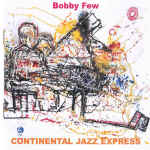
Artist: Bobby Few Album: Continental Jazz Express Label: Boxholder Review date: Nov. 7, 2002 |
|
|
|
|
Lyrical, Romantic Free Jazz
Bobby Few’s Continental Jazz Express, recorded at the 2000 Vision Festival, is a frustrating mix of rich, flowing piano playing and so-so sound quality. Few grew up in Cleveland with Albert Ayler and made wild free jazz records with the likes of Alan Silva and Frank Wright in the late 1960s and 1970s. But his playing here, while not at all tame, is more lyrical and Romantic (with a capital R) than his background suggests.
Few’s tendency to play busy chordal patterns with his left hand while playing tumbling arpeggios with his right makes his work sound a bit like a cadenza in a 19th century piano concerto. Still, there’s no mistaking his avant-garde jazz pedigree – not only is most of Continental Jazz Express rhythmically and harmonically free, it also contains plenty of bluesy phrasing. Few is in fine form throughout most of the album, and especially so on two lengthy renditions of its title tune, which feature busy, percussive soloing and a complex theme that mixes a blues melody with emphatic locomotive rhythms.
Few’s excellent work at the piano would, however, be easier to enjoy if his playing had been a bit clearer. Few tends to hold down his sustain pedal a bit too much during the wilder, louder sections, making it difficult to hear the individual notes in his dense, tricky left-hand chords.
Another problem with Continental Jazz Express is its theme. Few’s train isn’t just continental, but global, as the second and third tracks here are called “Africa” and “China,” respectively. “China," which mostly consists of strings of quasi-Asian parallel fourths and Few yelling, “Chiiii-naaa,” is especially annoying. This sort of lazy, kitschy appropriation of non-Western musics is one of the most obnoxious conceits in free jazz. Ed Hazell’s liner notes claim that Continental Jazz Express “transports us on a journey through time… and beyond time into metaphysics… It is a universal journey.” It’s as if the idea of free jazz as a boundary-smashing, transcendent activity (an idea Few apparently inherited from Ayler and John Coltrane) leads Few to believe that he can somehow say something meaningful about Chinese culture without really trying.
Still, fans of dramatic, lyrical out-jazz may find it worth their while to ignore the album’s central concept and its muddy low end. Listeners who skip “China” and ignore the song titles won’t have to deal with Continental Jazz Express’s unfortunate global-journey theme, and Few’s power at the piano clearly shines through even if we can’t hear every last note.
By Charlie Wilmoth
|





 View all articles by Charlie Wilmoth