|
|
 |
Dusted Reviews
Artist: Ustad Shahid Parvez / Lalgudi G. Jayaraman Album: Kushal / Violin Soul Label: Felmay Review date: Jun. 29, 2007 |
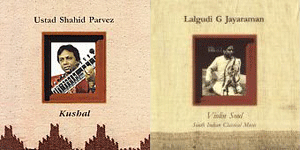
|
|
|
|
Shahid Parvez might not have a household name, but he delivers where a Hindustani musician must. His hour-long performance of “Raga Shyam Kalyan,” the evening raga that comprises this album, unfolds with grace and clarity. It is by turns hypnotic and exhilarating, and never lapses into either slack blandness or some monstrous display of virtuoso ego.
Instead the sitarist displays a sure sense of control, building the piece several times to a low-boil intensity that derives from dense but uncluttered divergences at a generally leisurely pace. He evinces a strong sense of proportion, building tension by slowing and spacing his phrases as well as accelerating them. The album also creates a sense of place and time; during the more leisurely moments, you can hear some kids hollering in the distance and even some crickets buzzing in the background. Tabla player Pandit Sankha Chatterjee sustains respect for the raga’s atmosphere by limiting his improvisational forays, although he does get off some brief, fleet elaborations that set Parvez up for another slow spiral through the raga’s structure. Parvez also attends to texture; the piece’s conclusion owes its edge-of-the-seat excitement as much to the sitar’s expanding drone as it does to his increasingly forceful statements of the melody.
In Indian classical music, nothing rates higher than the human voice, and players of other instruments are judged in part on how they rate to it. Violinist Lalgudi G. Jayaraman, who plays in the Carnatic tradition that originated in Southern India, approaches the voice from two angles. First, he is renowned as a singer’s accompanist, a skill set that’s apparent even though no one opens their mouth on Violin Soul.
The way he pitches his fiddling in relation to that of his son Lalgudi G J R Krishnan, shifting smoothly between impeccable unison lines, traded phrases, and closely argued commentary pitched slightly above the younger violinist’s lines, indicates a high level of attunement to other musicians’ inflections and melodies. Second, his tone is quite vocal; he obtains an imploring quality on “Pariyaachakama” (at 7:13, the shortest piece on this hour-long CD), and sounds warm and almost teasing on the much longer “Kamalaambaam.” According to the liner notes, he plays the latter piece’s original lyric, and his flow is so intricately inflected that it’s not hard to believe the claim. The two violins stick so closely to each other that the divergent rhythms of percussionists Karaikudi R. Mani (mridangam, a wooden drum) and T H Vinajakram (ghatam, a clay pot) unfold in stark relief.
Regrettably, the album’s presentation doesn’t really do the music justice. Tracks begin and end abruptly, as though someone just snipped the tape while the tambura was in mid-drone, and some occasional blurriness in the higher frequencies betray the fact that this record was originally released on cassette. Even so, it’ll still sound pretty hi-fi to your average Vibracathedral Orchestra fan. More annoying are the notes, which are long on hyperbolic description and short on hard information.
By Bill Meyer
|





 View all articles by Bill Meyer