




|
|
|
|
|
|
|
|
|
|
||||||
| |||||
|
|
||||||||||||||||||||||||||||||||||||||||||
|
|
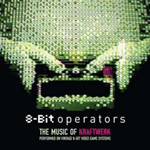
The premise of 8-bit Operators: The music of Kraftwerk was originally an April fools' joke by the band 8-bit Weapon, who posted the idea on a message board. Fans of chiptune music have long found camaraderie on Internet Bulletin Boards and on fan-run sites such as Micromusic, and it didn't take long for a collection of tracks from around the globe to start pouring in.
To wit, Ralf (Hütter) and Florian (Schneider-Esleben) of Kraftwerk were among the first to use computers as musical performance machines in the early ’70s. By the end of the decade, Kraftwerk had pioneered the use of animatronics and handheld electronics in their live shows to effectively take their entire studio on the road with them. On their 1981 Computer World tour, the band famously performed on stage using little more than their "pocket calculators" as instruments.
Jumping to 1983, a young composer by the name of Koji Kondo was hired by a relatively unknown company called Nintendo, to compose music for their Famicon gaming system. Two years later, he would create one of the most recognizable tunes in the entire world, using the limited palette of four instruments that were available to him on the system's sound chip (two monophonic pulse channels, a monophonic triangle wave channel and a noise channel that is used for percussion). That theme song to Super Mario Brothers would become instantly recognizable and ignite a revolution of devotees to what is now referred to as "8-bit" or "chiptune" music.
Perhaps the greatest invention to come from the love of chiptune music would be Oliver Wittchow's Nanoloop. First developed in 1998, Nanoloop is a 16-step pattern sequencer for the Nintendo Gameboy (a cartridge) that literally allows the user to play the Gameboy as an instrument. This piece of equipment, alongside other hardware like the Sid Station, made it possible for musicians to step outside the world of video game sound design and onto the dance floors.
Realizing that live performances within the Gameboy crowd had a striking resemblance to Kraftwerk playing their pocket calculators, Jeremy Kolosine of Receptors Music began compiling all of the message board submissions into what would eventually become 8-Bit Operators. Kolosine made sure that alongside prolific artists in the genre, he also included the architects behind the technology that made 8-bit music performance possible, such as Nanoloop creator Oliver Wittchow and Johan Kablinski, the creator of Little Sound DJ.
Similar to their origins, the majority of these tracks pull off the amazing feat of sounding futuristic yet simultaneously retro. Bacalao's "The Robots [Die Roboter]" is a skittery jackhammer jam, with twisted drumbeats and breathy, processed vocals sung in German. Glomag's version of "Pocket Calculator" is an exceptionally playful recreation with herky-jerk, Devo-esque vocals and steam-static drums that ping-pong all over the mix. Covox cranks out a Mega Man-inspired version of "Computer Love" that is slow and plodding, with a fantastic percussive back beat that would have translated just as well to an intro of "Trans Europe Express.”
Where the first half of the record relies on dance-floor remixes, the second half starts to delve into wilder territory. Wittchow,takes on the lesser-celebrated "Kristallo," while David E. Sugar's version of "Radioactivity" quickly devolves into happy-hardcore, spastic-child-dance madness that is almost unrecognizable until the last 10 seconds of the song. 8-Bit Weapon's version of the almost unknown "Spacelab" starts like the soundtrack to an old horror movie, one reminiscent of the electronic soundscapes on Air’s Moon Safari.
Overall, the reverence that these artists have for Kraftwerk shines through in their meticulously crafted renditions. Whereas most covers compilations are completely indulgent and self-serving, 8-Bit Operators holds up on its own merits, and manages to serve as a perfect snapshot of a vibrantly talented group of electronic artists paying homage to their musical forefathers. By Dustin Drase
|
||||||||||||||||||||||||||||||||||||||||
|
||||||||||||||||||||||||||||||||||||||||||
| |||||


 View all articles by Dustin Drase