|
|
 |
Dusted Reviews
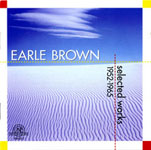
Artist: Earle Brown Album: Selected Works: 1952-1965 Label: New World Review date: Jan. 11, 2007 |
|
|
|
|
August 5, 1959: American Composer Earle Brown writes to Italian Composer Luigi Nono. His concerns? “Chance,” “time,” finding a way to let the “fantastic exist” also in his ears. Twenty-one days later, Brown again writes to Nono. His concerns? “Time,” “freedom,” the “indeterminacy” and “immediacy” of the performer. Of the 10 works included in Selected Works, seven predate the aforementioned correspondence. The three that don’t bear the marks of invention and restless search; they are not only the most rigorous; they are also the most successful of the lot.
“Times Five,” penned in 1963, confines similar tonal clusters to slave quarters. The close living becomes slowly aggravating, eventually proving too much as flute, harp and violin spar. Finger and breath, saliva and speed, slip and slide, inhale and exhale – their shapes determined; then confused; then quickly unraveled. This sort of clownish mimesis persists for nearly three minutes. What follows is a talky, messy din of misguided interrogation, which – in the end – settles for near silence; the Super Ball sonics of manipulated tape perforating the nothingness with bouncing parabolas of sound.
1962’s “Novara,” shares similar characteristics, yet showcases an instrumental respect – a sort of selfless will to “play well with others” – that the rambunctious “Times Five” lacks. “Novara’s” strings are exquisite. Like sand crabs scared from their beach holes, they click and pop and run to join the vociferous gulls in a fortunate feast. The string tones continue to draw and release, like beaks they jab and peck; the piece’s body a ragged coat – bloodied as pinchers and talons probe its carcass. A clarinet sputters about, its musician more evident than the instrument as wet breath bites and lags on a gnawed reed.
The latest and strangest of the lot is 1965’s “Nine Rare Bits,” which sounds like a gaggle of crackheads loosed on a couple of harpsichords. It seems that hands and feet work just as well as elbows and knees, as resonate decay obviously matters as much as a 40-fingered smash. Henry Cowell, had he gotten into Cecil Taylor and street drugs might have managed something as elegantly violent as “Nine Rare Bits.”
Ultimately, these pieces sound like what they were: Brown working out his ideas on paper. Were Brown not such an annoyingly against-the-grain composer, these would all be relegated to the historical dustbin. Yet, for all the whimsical incompleteness of this collection, the pieces stand on their own as sorts of compositional proofs: incontrovertible evidence that Brown was working through his preoccupations with time, chance, freedom, indeterminacy and immediacy. The lot of these are occupational hazards for current would-be “avant-gardists.” In Brown’s hands, however, they were a way to let the fantastic exist – even if it never filled his own ears.
By Stewart Voegtlin
|




 View all articles by Stewart Voegtlin