|
|
 |
Dusted Reviews
Artist: Tony Conrad Album: Joan of Arc Label: Table of the Elements Review date: Nov. 26, 2006 |
|
|
|
|
Every sort of organ sounds different, but every other sort of organ sounds the same compared to the pump organ. It gets its breath through pedal-powered air pressure, and its sound is warped and wobbly, trembling and inconsistent. It’s the moodiest of all organs. Once an accompanier of hymns and a visible presence in American living rooms, it was already scarce by the time Naomi Barfield’s exemplary long-player The Old Pump Organ appeared in the ’50s.
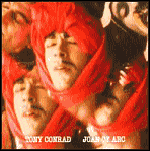
A decade later, it’s the instrument that minimalist avatar Tony Conrad chose for his musical contributions to Piero Heliczer’s ’68 art film Joan of Arc. (That same year, Conrad starred in Ira Cohen’s psychedelic classic Invasion of the Thunderbolt Pagoda, a flick for which he clearly feels a greater affinity; Joan of Arc’s cover is actually a still from Pagoda, and Heliczer isn’t even mentioned in the thank-yous.) In some cases, the nicest thing one can say about a soundtrack is that it “transcends soundtrack-y-ness” (or perhaps something similar but less awkward). In this case, Conrad doesn’t need to transcend anything. His art is psychic aikido. Your brain does most of the heavy lifting.
As in most of Conrad’s work, the pace is glacial. This disc can sustain one mood, one tone, until it plumbs the full range of human emotion. But the pump organ lends this piece a unique spookiness. It often sounds like a record that’s warped or badly pressed. Ten minutes into a mantra, the organ threatens to lunge into some other mode altogether. Such are the hazards of meditation when you’re defined by your imperfections. Joan of Arc is never fully in the dark and never finds the light, but drifts slowly and eerily in between, over the course of a disorienting, exhilarating hour.
It’s impossible to measure Tony Conrad’s lifetime impact on underground music; if your reference points include the Velvets, Sonic Youth, John Cage or any other musical entity that’s ever exuded a certain negative, willfully monotonous, undeniably spellbinding cool, he’s simply the guy. Whether or not Joan of Arc ranks with his “essential” work sort of depends. But as it channels Conrad’s distinctive hypnosis technique with one of the most lovably unsteady instruments available, it’s both a glorious mindfuck and an informative study in contrast.
By Emerson Dameron
|




 View all articles by Emerson Dameron