|
|
 |
Dusted Reviews
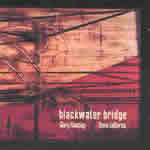
Artist: Hassay/LeBaron Album: Blackwater Bridge Label: Drimala Review date: Aug. 12, 2002 |
|
|
|
|
There has to be a reason why so many of the biggest names in free jazz and improvisation — including Ornette Coleman, Anthony Braxton, Archie Shepp, Peter Brötzmann, Evan Parker, David S. Ware and many others — are saxophonists. It’s probably partially a coincidence, but I’m guessing the high number of famous saxophonists also has something to do with the saxophone itself: because of its timbre and the effort required to even make a noise on it, the saxophone commands attention as soon as it’s played. Saxophones (with the possible exception of the baritone sax, which isn’t used in free jazz nearly as often as the alto or tenor) don’t work very well as background instruments; they’re too flamboyant sounding. So this CD, in which saxophonist Gary Hassay is accompanied only by the wispy glissandi of Anne LeBaron’s harp, is a curious one. The album is ultimately a success, however, due to the two players’ charming search for common ground.
LeBaron knows that without a rhythm section backing her, she’d sound a bit ridiculous attacking her harp the way Alice Coltrane did, for example, on 1971’s Universal Consciousness. On the second half of the album, LeBaron steps out a bit—she offers thudding, low-end stomps at the beginning of “Never Told Tales,” and on “FRISSON,” she plays in startling start-stop blurts that feel a bit like going over a speed bump too fast. But for the most part, LeBaron stays pretty calm, plucking pensively at thin chords and scraping the ridges of her strings to create eerie scratching sounds.
Hassay’s saxophone, then, is necessarily the focal point, despite Hassay’s attempts to give LeBaron room to move. Hassay eschews the innovations in extended technique developed by Braxton, Albert Ayler and others, playing with a full, straightforward tone that wouldn’t raise eyebrows in a bop combo. Like Fred Anderson and late-era John Coltrane, though, his approaches to harmony and rhythm are far from conventional. Here, he sounds purposefully uncertain, playing tentative, slurred phrases as he tries to fit into the tapestry woven by LeBaron.
Despite their valiant attempts, though, Hassay and LeBaron’s instruments are too different for their work as a duo to really gel—Blackwater Bridge shows two players looking for and never quite finding each other. Hassay’s saxophone is a bit too heavy to sound as one with LeBaron’s harp. Paradoxically, though, it succeeds almost because of that fact: Hassay and LeBaron are each capable of sustaining interest on their own, and it’s strangely touching to hear them straining to find common ground. And when the music does cohere, like in the flying arpeggios at the beginning of “Memoire Involontaire,” it highlights the difficulty of Hassay and LeBaron’s task — making their musical partnership work.
By Charlie Wilmoth
|




 View all articles by Charlie Wilmoth