|
|
 |
Dusted Reviews
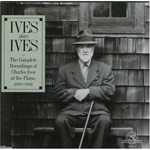
Artist: Charles Ives Album: Ives Plays Ives, 1933-1943 Label: New World Review date: Jun. 25, 2006 |
|
|
|
|
Charles Ives’ talents were prodigious. And though he made his fortune as an innovator in the New England insurance business, his powerful abilities as a visionary composer with a uniquely American approach were, for most of his lifetime, unheralded and unrewarded. Thus, when Ives began in the 1930s to record his own work on piano, it was as a form of creative workshop: a chance to document his own fertile imagination; a chance for the composer himself to sit back and listen critically to the realization of music that had never been performed in public. As such, the recordings collected here (a welcome re-issue of a 1999 disc on the, alas, departed CRI label) give a fascinating look both at Ives’ obsessive penchant for revision and improvisation and his mercurial tendency to jump from idea to idea in music that twists and leaps at the speed of thought.
Ives spent a lot of effort, it seems, re-working and re-casting the material of his unfinished Emerson Concerto. (Some of its themes came from, or ended up in, other works. And Ives himself eventually took pleasure in the very idea that the piece would never be finished, rather re-worked throughout his entire life.) Indeed, one might sense, in the composer-pianist’s headlong rush of ideas and executions, a breath-taking restlessness of spirit. This is especially evident here in his piano music, where the orchestral tonal variety and spatial placement of voices that Ives often utilized for programmatic and pictorial effect are absent, resulting in a more abstract music of “ideas’ – and a sense, sometimes, of crazy radio dial-spinning, with snatches of marches, hymns and dissonant melody clusters accruing and dispersing in profusion and constant change.
And then there’s Ives’ piano playing, a revelation to those who haven’t heard it and who think they know his music. There’s a definite late-romantic sensibility to his style and technique: it’s fast and furious, full of flourishes and liberties with tempo, rumbling and thundering in the lower-ranges despite the surface noise and the severe dynamic limitations of the disc-cutting technology with which it was recorded.
The final session here from 1943 is, to put it simply, a remarkable and moving document of American music. Mary Howard, of Mary Howard Studio in New York City, managed to capture both the limpid elegance and roaring passion of Ives’ performances. Among the treasures captured are three takes of Ives’ strange and stirring patriotic march/song “They Are There.” The singer Ives bellows and exhorts his way through the stomping, pounding piano accompaniment – with all its herky-jerky jump-cuts and musical interpolations – sounding like a slightly unhinged Irish tenor. (“Smash all dictators!” he interjects.)
As a last word, there’s the closing piece, the lovely, hymn-like “Alcotts” movement from the Sonata No. 2; Concord. It’s as lucid and balanced a piece of piano music as might exist; gently dissonant at times and formally graceful throughout, suggesting perhaps, a breeze through an open, curtained window. Performed by the composer with perfection of touch and execution, it sheds a softer light on the urge for emotion and expression at the heart of Ives’ sometimes thorny and rigorous art.
By Kevin Macneil Brown
|





 View all articles by Kevin Macneil Brown