|
|
 |
Dusted Reviews
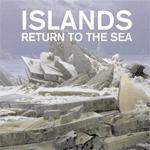
Artist: Islands Album: Return to the Sea Label: Equator Review date: May. 29, 2006 |
|
|
|
|
An album called Return to the Sea by a band called Islands is a lot of metaphorical ground to cover right off the bat, and admirably ex-Unicorns J'aime Tambour and Nick Diamonds (not their real names) make no particular effort to instill any consistent meaning in it. Much of the record's charm is its loose, unhurried spirit, the tidal regularity with which clarity drifts in and ebbs away. Most of the songs refer on some level to natural disasters or sea creatures or other hammy elemental imagery, but collectively they bespeak nothing so much as a simple, almost childish fascination with being – being free, being in love, being human. It would be ill-conceived conceptuality if Islands pushed the point; the beauty is that they don't.
For starters, Diamonds words his ruminations with a lovely and often eerie simplicity, and sings them just as they should be sung: conspiratorial triumph (”Hungry humans, we've got to eat some of them/ We'll burn those bridges when we come to them/ I'm not just their leader, I'm also one of them”), lovesick resignation (”If you ain't sweet to me/ I'll desert you in a heartbeat/ If you don't savor me/ I'll salt you, make you savory”), what have you. The way he wails ”I/ Woke up thirsty/ The day I died” in the nine-and-a-half-minute opener "Swans (Life After Death)" is unforgettably unsettling.
The other beauty is that the music suits this mode of expression and exploration exactly: it's gentle and breezy, tentative and adventurous at the same time. Like most of Canada's best recent releases – take the Arcade Fire and Wolf Parade, both of whose members pop up often here – Return to the Sea is clamorous and messy, each song a bit more of a kitchen sink than it strictly requires, but the mess is refined and strangely poignant. The scrappy urgency of the Unicorns' Who Will Cut Our Hair When We're Gone? remains, in squeaky synths and laconic disco beats (see especially "Where There's A Will There's A Whalebone" and the gritty breakdown at the end of "Swans"), but it doesn't get the spotlight.
Instead, the majority of the record is given over to an odd and winning reticence, a breath of arcane air just where dull cynicism (lyrical as well as musical) has become the standard. The Unicorns sprawled; Islands build up, not out. With this record Diamonds and Tambour translate their curiosities into creative augmentations of sweet, simple and trustworthy melodies, rather than navelgazing experimentation or overstatement (Subtle and Busdriver's respective raps in the middle of "Will/Whalebone" are decidedly a misstep, but a forgivable one). There are old echoes moment to moment, but as a whole almost none of Return to the Sea would sound quite right under the Unicorns flag – not the sinewy instrumental "Tsuxiit," which turns chamber strings, flute and charango into baroque whale calls, nor the politely shuffling ditty "Don't Call Me Whitney, Bobby," which comes out of nowhere with a glib "Fuck what you heard."
"Rough Gem" (which manages to lift its hook wholesale from "We Didn't Start The Fire" and its subject matter from "Diamonds From Sierra Leone"), can be comfortably described as excitingly tasteful. In that apparent contradiction lies the curious brilliance of the Islands project: equal parts radical and reactionary, it belongs just as easily to some half-baked post-apocalyptic waterworld as to the past or the present. Return to the Sea reins in its eccentricities successfully enough to illustrate that the most understated risks can be the most rewarding.
By Daniel Levin Becker
|





 Vapours