|
|
 |
Dusted Reviews
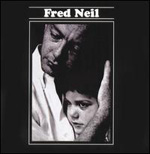
Artist: Fred Neil Album: Fred Neil Label: Water Review date: May. 20, 2006 |
|
|
|
|
You might think that giving Bob Dylan his first gig in New York, or penning the theme song to a Best Picture Oscar winner, would be enough to keep your records in print, but for 40 years Fred Neil’s best album was astonishingly difficult to find. Recorded in 1966, and released twice – in 1967 as Fred Neil and in 1969 as Everybody’s Talkin’ – the 10-song LP was roundly ignored by critics and listeners, causing Neil’s swift exit from music to be overlooked by nearly everyone, including devotees to artists whose careers he helped to nurture ––Dylan, Stephen Stills, David Crosby, Tim Buckley and Harry Nilsson. Over the last few years, a handful of labels have sought to rectify the dearth of available Neil material, packaging his self-titled album with the rest of his Capitol recordings in 1999 (The Many Sides of Fred Neil) and with his Sessions record in 2003 (Do You Ever Think of Me?). But Water’s new reissue of Fred Neil hardly feels redundant as a stand-alone release; it will probably always be too slippery to find a place on those lists of totemic ’60s masterpieces, but Fred Neil is possessed of a shimmering, soulful beauty that is uncommon in any era.
Neil was the consummate anti-careerist, which is partly why his encounter with the ambitious Dylan – particular as described in Dylan’s Chronicles – is so interesting. The two met at a crossroads, and passed quickly by. The rock legend writes about arriving in New York in the dead of winter: “I didn’t know a single soul in this dark freezing metropolis but that was all about to change – and quick.” He tells about loitering around The Café Wha?, the Greenwich Village club where Neil performed, and he describes rather aptly the man’s signature style: “He played a big dreadnought guitar, lots of percussion in his playing, piercing driving rhythm – a one-man band, a kick in the head singing voice.” Pages later, Dylan writes, “I had stopped going down to the Café Wha? in the afternoons. Never stepped foot in there again. Lost tough with Freddy Neil, too.” In every account of Neil, his indifference to success seems to baffle people. “Fred never gave a damn about the business,” one collaborator says in the reissue’s liner notes. He seemed content to leave his songs by the side of the road, knowing that anyone who came along to find them would be forced to tangle with them for a while.
It’s worth belaboring Neil’s association with Dylan because the latter casts the former in such stark relief. Dylan had that famously slack and nasal voice that tore across the cultural and historical landscape like a brush fire. Neil, by contrast, had a voice like an anchor – a weighty, bottomless tone that plumbed the depths of human existence. The vaguely Eastern guitar tones on “The Dolphins” seem to ripple like water away from that booming human instrument, patiently searching for a place of rest. ”I only know that peace will come when all hate is gone / And I’m searchin’ for the dolphin in the sea.” Elsewhere Neil wraps his vocal cords around snippets from Rev. Gary Davis’s “Cocaine Blues” (“Sweet Cocaine”) and Bo Diddley’s “Who Do You Love?” (“Green Rocky Road”), turning the former into a lazy bit of streetwalking jazz, and cooing the latter like an invitation to whisper your lover’s name in his ear.
My favorite song of Neil’s is his cover of “Shake Sugaree” (“I’ve Got a Secret”), which bears such scant relation to Elizabeth Cotten’s original that it’s difficult to understand how they both can be so perfect. Neil takes Cotten’s sweetly austere ditty and stretches it like taffy, the twinkling strings and playful whistles that open the song seeming to orbit his basso as he pumps great quantities of air into and out of his lungs. The record’s best moment occurs roughly halfway in – he’s already sung about pawning off his material possessions, and he’s left with only the notes of the song as he belts, “You know I’ve got a song to sing, not very long / And I’m gonna sing it right if it takes me all night long.”
Many accounts of Neil, who died in 2001, portray him as an evasive figure – moody, dissatisfied, and searching. But few singers sound as comfortable in their skin as Neil does in these recordings. His laconic, bluesy style seems specifically selected to allow him to elongate those deep, rich, echoing notes. The man’s lungs seem big as cathedrals; every time he draws a breath, what pours forth is so rich and inexhaustible that it’s amazing it’s been such a chore to track down until now.
By Nathan Hogan
|





 View all articles by Nathan Hogan