|
|
 |
Dusted Reviews
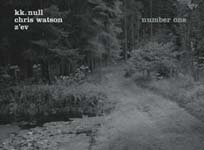
Artist: KK. Null/Chris Watson/Z'ev Album: Number One Label: Touch Review date: Jan. 29, 2006 |
|
|
|
|
Aficionados of Japan’s traditional Noh theater might be hard pressed at first to find even a scant few hallmarks of the centuries-old artform in Number One. But, as Z’ev details on the Touch website, Noh served as the inspiration and the formal guidelines for the creation of the album, with the trio engaging the idea of musical theater from a novel perspective; as the disc progresses, the “characters” defined in its opening scene are recontextualized within the traditional Noh cycle, assuming new roles to match the theme or atmosphere usually assigned to each segment. Z’ev served as the play’s director, the final arranger and editor of the sounds, but (as can be seen on a project log on his website) the creation of Number One was a highly collaborative process. Though Noh was the definitive guide in the creation and placement of sound, it’s quite easy to listen to the disc in its entirety without a thought of the Japanese art form. Luckily, Number One isn’t purely a conceptual project, and regardless of how interesting or different the artists’ approach, the album’s music is strong enough to stand on its own without any detailed explanations needed.
Number One began as a vehicle for collaboration between Z’ev and KK. Null, but Chris Watson, a later addition to the plans, is the album’s most important contributor. Watson’s African field recordings, included on each track, serve as the most concrete link between Number One and its Noh-inspired trajectory, with each selection corresponding to the traditional theme of each part of the Noh cycle. The recordings are panned hard right and left, and serve as a boundary within which the electro-acoustic sounds of Null and Z’ev interact. More than a third actor, Watson’s selections are each act’s stage and scenery, more an omnipresent reminder of the atmosphere than another active voice in the music.
Were Watson absent, the tones and undulations of Null and Z’ev wouldn’t carom uncontrollably away from the inspirations of Noh, but what the field recordings have to offer, both musically and conceptually, cannot be ignored. Z’ev makes reference to his attempts to match similarities in sound, aiming for output that would fit within and mesh well with the details of Watson’s offerings. The dissonance between the organic and artificial is jarring at times, but, throughout the majority of the disc, Z’ev expertly weds the sound sources; even if there are no striking similarities in their actual sounds, the thematic parallels are exploited quite well. Watson’s recording of an upcoming storm and its noisy arrival is complemented by a cloud of static that, while likely made without wind and rain in mind, fit comfortably within Watson’s panorama. There are times, notably in the disc’s first two tracks, that the field recordings are obscured, or, momentarily, completely buried by the electronics. It’s these moments that feel the most obtrusive in Number One’s five-part cycle, the most detached from the original goal of the piece.
Noh traditionally makes use of minimalist scenery and props, forcing the utilization of imagination to fully realize the action taking place onstage. Number One takes a similar approach, not presenting the musical manifestation of Noh in such a blatant way as to interfere with the quality of the music; rather the performance takes precedence over more concrete and formal concerns. And while the disc’s “story” may not be so defined as that of its Japanese inspiration, Z’ev, Null and Watson, much like the actors in a Noh performance, make the telling of a story more of an event than the tale contained therein.
By Adam Strohm
|





 View all articles by Adam Strohm