|
|
 |
Dusted Reviews
Artist: David Grubbs Album: Two Soundtracks for Angela Bulloch Label: Semishigure Review date: Jan. 5, 2006 |
|
|
|
|
I would never offend David Grubbs’ sensibilities by referring to him as a ‘multimedia’ artist, but he is one of the few artists extant who is in his element when sifting between art forms. Grubbs has worked alongside artists Stephen Prina and Albert Oehlen in The Red Krayola, releasing Oehlen’s own recordings (with his brother Markus, as Van Oehlen) on the Blue Chopsticks label; Grubbs’ own Thirty Minute Raven is an edited highlight of an hour-long piece installed at the Centre Pompidou. Furthermore, Grubbs recently released a collaborative recording with poet Susan Howe entitled Thiefth. Two Soundtracks for Angela Bulloch continues in this vein, though the relationship is more complicated, as the Bulloch works that Grubbs has soundtracked, Z Point and Horizontal Technicolour, refer back to Antonioni’s Zabriskie Point.
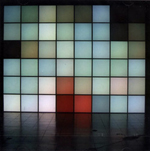
To that end, Grubbs draws “Z Point’s” source material from the soundtrack to Antonioni’s film. His editing hand ensures a circular logic to the composition: this is a key trope to Grubbs’ extended pieces, which generally hover around a clutch of structuring motifs. Bulloch’s Z Point turns the explosion scene from Zabriskie Point into a ‘pixel module’ of blocks of color, and Grubbs uses explosion sounds as punctuation for his soundtrack. Minutes later the piece develops into a typically eloquent, ruminative acoustic guitar melody gradually accompanied by a distorted rock version of itself, like a stream of silver light shot into the body of the composition. The following “Horizontal Technicolour” sets Bulloch’s own film of Death Valley (one of the settings to Antonioni’s film) to mutable blocks of synth that tremble with tremolo, dissolving into silence and then reappearing in cyclical fashion.
Grubbs’ instrumental compositions sound as though they are repeatedly questioning their own decisions; there is a critical internal rigor to Grubbs’ work, and his compositions shift slowly, taking on new meanings as they connect with varying contexts. In this respect, his art may well be much like that of Bulloch, whose work Beatrix Ruf suggests, “reveals the constant flux of things caused by the projection of ideas and concepts onto locations, objects and realities which actually exist.”
By Jon Dale
|





 An Optimist Notes the Dusk