|
|
 |
Dusted Reviews
Artist: Albert Ayler Album: Slugs' Saloon Label: ESP-Disk Review date: Dec. 11, 2005 |
|
|
|
|
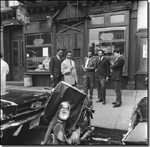
In the spring of 1966, Albert Ayler was in the midst of a yet another transitional period of his meteoric career. Charles Tyler and Sunny Murray were gone from his group, neither to return. Brotherly love still prevailed and Donald remained his principal foil on trumpet, but fresh recruits occupied the other band chairs. Classically trained violinist Michel Samson was the free jazz greenhorn, on the payroll for just a few weeks. Completing the working quintet were bassist Lewis Worrell and drummer Ron Jackson, a full decade before his membership in Cecil Taylor’s Unit and future fusion projects like The Decoding Society and Last Exit even farther off. On May 1st, Ayler set up shop at an East Village venue that had been one of his regular haunts since late 1965. In a stroke of good fortune, the ESP tape machines were present to capture the sounds.
The five familiar pieces on Slugs’ Saloon follow the common Ayler custom of using majestic, madrigal-like themes as wind tunnels to generate swelling bursts of centrifugal musical force. While the barely bridled ensemble inertia occasionally spins off into pealing, atonal chaos, the fulminations are always righted by reliable returns to stabilizing melody. Samson and Worrell suffer in the mix, particularly when Jackson’s sticks are pistoning at full strength, but overall the fidelity improves substantially on past editions. Coarse edits and fades close several of the tracks and suggest that a “complete” edition of the evening’s musical events will likely never surface. But grousing about what’s absent is akin to looking a gift horse in the mouth, especially considering that what has survived remains the only extant recording of this particular Ayler amalgamation.
A product of Donald’s pen, “Our Prayer” exudes an even greater amount of regal pomp than the opening rendering of “Truth is Marching In.” Tenor and trumpet strut through the resplendent fanfare like two field marshals wielding gilded batons, dressed in the finest military regalia, epaulets gleaming. Jackson raises a tidal deluge of martial tattoos, and the five men descend into a disorienting whirlpool of cathartic protean sound. Ferocity eases in an interlude of hummingbird arco tones, the drummer scuttling away quietly at the fringes, obviously aching to cut loose again. His patience earns reward in a renewed sortie signaled by a stentorian blast from the leader’s blunderbuss horn.
“Bells” takes shape out of a funereal dirge sketched in somber vibrato-drenched hues, a slow underlying cadence stretching the arching ensemble pathos to the point of near parody. String tones oscillate and warble with the imperfections in the source tape, but the effect is strangely apposite. Jackson is again a tireless atomic dynamo, his limbs summoning frothing walls of percussive energy that push the band ceaselessly forward. Donald bleats and whinnies away, notes mashing together into metallic noise. Detours ensue and the players venture off into brief, but rousing subsets between thematic returns, the onset of a sudden edit silencing the joyous outbursts in mid-wail.
The music on the second disc is a bit more distant and diffusive. “Ghosts” spools out in an accelerating barrage, the simple title theme quickly dispensed with in favor of a succession of variants strung together by connective cartilage of free blowing and chamber-style strings. This performance in particular points to the relative interchangeability of Ayler’s motifs. True pockets of diversity arise out of how the band opts to populate the gulfs between thematic mile-markers. Ayler and Samson auger the opening minutes of “Initiation” for themselves, the dull thrum of Worrell barely audible in the background before the inevitable ensemble conflagration ignites in undulating waves for the next quarter of an hour. Concert-culled Ayler is such finite merchandise that nearly all examples are valuable. This set is especially so as the sole opportunity so far to hear a legendary band operating at a communal peak.
By Derek Taylor
|




 Lörrach, Paris 1966