|
|
 |
Dusted Reviews
Artist: Larkin Grimm Album: Harpoon Baptism Label: Secret Eye Review date: Oct. 12, 2005 |
|
|
|
|
If folk music were a state, or a supermarket, “Provenance without proprietary” might be emblazoned across its flag/oversized plastic banner. The stately spirits of a few American forefathers have left an imprint severe enough that it might as well be on parchment; but, conversely, its hallmarks have been hijacked, appropriated, tainted, subverted, and generally confused since the first ‘Race Record’ was released by Ralph Peer of Okeh Records in 1925 – rural black musicians performed what white-owned record companies determined to be folk music, which was then sold back to black audiences as their own. (Peer’s reign of leering miscegenation also produced the first hillbilly record – he coined the term ‘Hill Billies’ as a name for Al Hopkins’ 1925 string band, which was marketed to southeastern, working-class whites.)
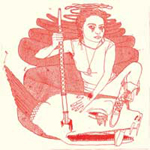
There’s no one thing that folk music, and only folk music, has. From Blind Willie McTell to the Sacred Harp Singers to Bruce Springsteen’s Nebraska, there has always been something happily elusive about music that could be labeled as such, making the term itself seem arcane; still, like pornography, sometimes you know it when you see it. Larkin Grimm’s Harpoon Baptism is folk music in all its ramshackle beauty, equally imperfect and rapturous, familiar and estranging.
Grimm’s sonorous voice, guitar and dulcimer plot a path through weird, old musical landscapes, leaving them coated with a gray ambient dew. On “Patch It Up,” clattering bells and a harshly-picked guitar meander around a bare rhythm as Grimm’s voice hums from side to side. The ringing dies down and a lithe blues-inspired chorus skips around a lightly-beating guitar chord. These are old songs or, at least, the bones of them; Grimm manages to tear apart the fabric of these songs on one hand, and lovingly reconstruct them on the other. On “Pigeon Food,” Grimm and her chorus sing like sirens proudly serenading an ominous spirit.
There is a price, of course. Intrepidness sometimes comes as a happy product of novelty, and this has some of the marks of a debut. Parts are played awkwardly, the volume of Grimm’s voice at times suppresses all else, and a few songs include passages with overbearing stereo effects and reverb. On “Harpoon Baptism,” Grimm slips too far from nimble storytelling to distended monologue. But for the most part her singing retains the lovelorn humor of early folk’s ecstatic depressives, and the heavenly female chorus – all Grimm’s own vocals – brings a taste of the coming judgment.
The most interesting contemporary folk music is usually not recognizable as such – artists like Jack Rose and No Neck Blues Band extract and extrapolate, turning withered banjo riffs that stick out from some antique 78 into peripatetic historical exercises and rich ritualistic workouts. Grimm ably harnesses folk’s contradictions, believes in them with the fervency of a convert. But Harpoon Baptism is equally steeped in Georgia stomp and Georgian chant, capturing the sound of songs played and passed down through generations, moldy and pungent with age and meaning.
By Alexander Provan
|




 View all articles by Alexander Provan