



|
|
|
|
|
|
|
|
|
|
||||||
| |||||
|
|
||||||||||||||||||||||||||||||||||||||||||
|
|
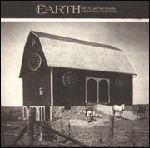
The German Lutheran and Swiss settlers of Pennsylvania’s formative period, like so many others before them, used geometric design to ape the celestial, the terrain, flora and fauna. The artistic language was crude, and fundamental; eventually signs not only proliferated, but also grew. Spheres mimicked the sun itself; setting largely across burnt red barns. The pictorial needed aural pronunciation; the two tongues, German and Swiss, swirled together, yielding Pennsylvania Dutch – and noun: Hexe. Colorful, and decorative motifs became “hex signs.” Talismans against drought; symbols of hope, fertility and faith, hex signs guarded the family, articulating purpose in shape, in color – a circle that had no beginning, nor end. How utterly perfect that Dylan Carlson’s Earth, with its fifth studio recording, selected this timeless semiotic: Hex’s music, like its figurative designation, draws boldly; draws broadly.
As the Roman god Janus was fashioned with two faces to see ahead and behind, Hex displays a macrocosmic quality; as most indigenous – or ethnic – music grows out of the thick roots of tradition, Hex is at once a stylish homage to its progenitors, and also a new, and powerful contribution to the lavish body of American music.
Hex’s breath is drawn from a massive array of palpable and apparitional sources, most of which taunt and tease, tricking the ear into hearing chords, lyrics or structures. Some are only mirage; others are as real as the road one walks upon. Carlson, however, isn’t out to deceive. His chords are rendered slowly – of course – but also with a bluesy economy, as Blind Lemon Jefferson or Charley Patton would slowly stitch their frustrations, their anger, into the open wounds of their day-to-day: Saving notes by bending them over the barrel; intimidating sound into shape.
Carlson takes this even further. The guitar structures are, from first listen, thin, nimble and spidery. Another listen hears the selfsame structures as thickset, paced and sentimental – deep as one of La Monte’s drones, as sugared as Ritchie Valens’ “Stay Beside Me.” From the “Land of some other Order,” to “Tethered to the Polestar,” Carlson’s Telecaster alludes to everyone and no one. There’s the shiny surf guitar of the young Jack Nitzsche; there’s the pastiche Americana of Ives; the avuncular ribaldry of early Willie Nelson, Hank Williams, Sr., Merle Haggard; the frayed instrumental patois of Bukka White, and David Allen Coe.
Hex is itself a symbol, a sign standing for, and to, all of the aforementioned. This is a music that moves in measure. Each step calculated, determined. Carlson’s guitar marking the progress; Dan Tyack’s lap and pedal steel tracing around his tracks. Drummer Adrienne Davies and bassist John Schuller play coyly: Schuller sometimes sitting back, watching Davies’ beats clap like screen doors in the wind; other times hooking arm ‘n’ arm, kicking up dust in the midst of Carlson’s sun.
Some pieces rise higher and heavier. “Raiford (The Felon Wind)” bends Tampa Red’s bottleneck around Louis L’Amour’s letters. “The Dire and Ever Circling Wolves” is a “Harlem Nocturne” transliterated for the beer’d and barbituric fandango, slowly slopping into narcotic hypnosis. Within the 15-minute thrall of these two selections is Carlson’s basic premise: Heaviness is no longer something hewed. Adhering to the “Special Low Frequency Version” would show atrophy instead of artistry. With Hex, Carlson & Co. articulate a delicate and confrontational music that spans the silent rage of Black Flag’s “Long Lost Dog of It,” and soft succor of Neil Young’s “Harvest Moon.” Rather than overextending, they ably reach into the murk of indefiniteness, where few – if any – have passed. By Stewart Voegtlin
|
||||||||||||||||||||||||||||||||||||||||
|
||||||||||||||||||||||||||||||||||||||||||
| |||||


 Living in the Gleam of an Unsheathed Sword