|
|
 |
Dusted Reviews
Artist: Susanne Abbuehl Album: April Label: ECM Review date: Jun. 20, 2002 |
|
|
|
|
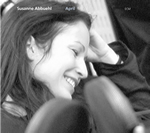
Something entirely new in the world of jazz vocals is something one doesn’t come across all that often. While there is great virtue and considerable craft in learning from and preserving tradition, there is a certain vertiginous exhilaration in stumbling on an album that seems entirely unmoored from the land of its predecessors. Such is the strange beauty of Susanne Abbuehl’s ECM debut April.
One unique aspect of this music is the new way in which the vocalist and the instrumentalists relate. Rather than the standard supporting role, the musicians here have unusually lyrical, impressionistic contributions that seem to be as much a part of the narrative as Abbuehl’s lyrics, advancing the mood and the overall theme. In the same way, Abbuehl’s lyrics often work more as music than as text. “I’m mostly interested in a very private kind of poetry,” Abbuehl says, “And also the poetry that is more about the things that vibrate with the words, where not everything is spelled out. Where, reading it, everything else comes across, the things that vibrate along with it and the things that are not said.”
Abbuehl was born in Switzerland, became interested in composition early on and began playing the harpsichord at age 7. After working on music for an exchange progam in Los Angeles, she returned to Europe to study jazz and classical voice at the Royal Conservatory of the Hague. Shortly thereafter, she began studying with Jeanne Lee, who would become one of her biggest musical influences. Lee was a central figure in adapting the free jazz ideas of the 1960s to the realm of vocalists, and worked extensively with Archie Shepp and other similarly creative artists. The effect Shepp and his colleagues have had on Abbuehl’s approach to music is obvious in the free-time vocal deliveries that rely very little on form, rather fitting music to the feel that the moment or lyric requires.
Another influence that Abbuehl pays heavy tribute to on “April” is Carla Bley. Four of the eleven tracks on the album feature Bley’s music, two of which have lryics by Abbuehl set over them and on a third, “Seven: somewhere i have never travelled, gladly beyond,” Bley’s music is used as a setting for e.e. cummings’ poetry. The fourth Bley tune, “A.I.R. (All India Radio),” was originally written for the Desert Band, featuring trumpet heavy Don Cherry. Abbuehl notes “A.I.R., indeed a rather unusual choice at first sight, has been one of my favorites for a long time, mostly...because of Don Cherry’s part in it. He is one of my favorite voices in jazz.” This track is one of the album’s high points, with wordless vocals doubled by Christof May’s clarinet wound around and through a haunting, repetitive vamp laid out by keyboardist Wolfert Brederode and percussionist Samuel Rohrer.
One way in which this album is still in touch with the standard jazz vocal repertoire is in the lyrics’ deep concentration on human, sexual relationships. But, in the capable hands of e.e. cummings, whose poems provide the text for five of the tracks, and Abbuehl herself, the ambiguities and unspoken elements of such relationships are given voice, rather than the often frivolous and saccharine copy that is so often on the lips of jazz singers. Set to Bley’s song “Seven,” cummings’ lines “your slightest look easily will unclose me / though i have closed myself as fingers” strike a note of tender wonder, as do Abbuehl’s verses “and the air is of gold / then you nearly unfold / as we move closer now: / the deepest is always.” April marks an exciting new direction in jazz vocals and a new way for music and words to work together.
By Bruce Wallace
|




 View all articles by Bruce Wallace