



|
|
|
|
|
|
|
|
|
|
||||||
| |||||
|
|
||||||||||||||||||||||||||||||||||||||||||
|
|
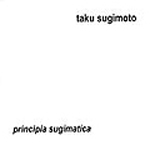
First, a complete description of what’s going on here: Taku Sugimoto plays a note or two on a clean-toned electric guitar, then rests for a precise period of time (exactly fifteen seconds, or exactly forty, say). Then he repeats the process, sometimes resting for a different, but still precise, period of time.
There’s nothing I need to add to that paragraph – I just described Principia Sugimatica virtually completely. If the above sounds like your idea of a good time, by all means, have at it.
Meanwhile, I’ll continue to try to find some reason to want to listen to this album again. Might it work as a Cageian comment on silence? If so, it doesn’t seem well suited to its studio recording, in which the “silences” are crisp and digital rather than unpredictable and alive the way they are in a live context.
Might it work as some sort of perceptual experiment? In headphones, it can be surprising when Sugimoto varies the lengths of pauses between notes, even when those silences are still ten seconds or more. He slows the listener’s perception to a crawl. Then again, spare, rest-filled music often messes with the listener’s perception, and the ultra-minimal and repetitive playing on Principia Sugimatica does not do nearly as much as it could to vary the listener’s relationship to the pauses. Tom Johnson’s Organ and Silence, for example, is similarly mathematical, but the silences feel different because of the ways Johnson uses the organ playing to set them up.
Might Principia Sugimatica work as some sort of comment on loud, busy, and technology-obsessed Japanese (and American) culture? In the November 2003 issue of The Wire, Sugimoto was quoted as saying, “…New things are in a sense imposed upon us. Mobile phones, computers, we must buy them. So the question is how to fight the imposed culture.” Why, then, does Sugimoto space his notes in seconds, which are an arbitrary part of this “imposed culture”?
And why is his playing here as mathematical and inevitable as the beep of a digital alarm clock? Sugimoto’s use of repetitive precision may somehow comment on the similarly precise, repetitive-sounding machines he’d like to fight. But I think the spare, imprecise and very musical guitar tangles of his early work already stood in sharp contrast to technology-sated culture while also being sensuous and touching in a way that his new regularly spaced beeps could never be.
By Charlie Wilmoth
|
||||||||||||||||||||||||||||||||||||||||
|
||||||||||||||||||||||||||||||||||||||||||
| |||||


 View all articles by Charlie Wilmoth