|
|
 |
Dusted Reviews
Artist: Devendra Banhart Album: Cripple Crow Label: XL Review date: Sep. 8, 2005 |
|
|
|
|
Devendra Banhart apparently doesn’t believe in time off: less than a year after the release of Nino Rojo, the second of his two full-length releases in 2004, the prolific troubadour is back with the 22-song, 74-minute Cripple Crow. Crow significantly marks Banhart’s first work independent of Young God Records owner/Angels of Light frontman Michael Gira: he produced and released Banhart’s last two records, and also more-or-less single-handedly brought him to the attention of the music world. The shift in producer and label is accompanied by a move into new stylistic territory: less folky and more eclectic than his past work, Crow offers ample evidence of growth in Banhart’s range as both a performer and a songwriter.
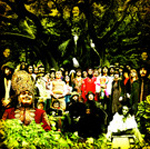
Whereas Banhart’s past three albums were essentially one-man shows, relying primarily on acoustic guitar and vocals, Crow works with a considerably broader palette: only two of the album’s 22 tracks are solo acoustic performances, and full band arrangements take priority. The intimate atmosphere of Rejoicing in the Hands and Nino Rojo is replaced here by a clear sense of community: Banhart’s collaborators (who include the kids from Feathers) are clearly audible, and he now plays the role of frontman, rather than that of lone singer-songwriter. The album art reinforces this sense, depicting a large group of bearded men and rustically-clad damsels that recalls the cover of the Incredible String Band’s The Hangman’s Beautiful Daughter.
Banhart seems more willing than before to reference other periods and genres: his past albums’ arguable indebtedness to Marc Bolan aside, Crow finds him engaging for the first time in blatant imitation, lending his trademark warble to songs that mimic late-’60s blues rock (“Long Haired Child”), Lovin’ Spoonful-style jug-band folk (“Some People Ride the Wave”), and Neil Young-inspired country-rock (“Hey Mama Wolf,” “Korean Dogwood.”). This isn’t to say that Banhart has abandoned his own style to slavishly imitate others; rather, he tries on a multiplicity of voices here, marking a sharp contrast to his relatively homogeneous earlier work. Some listeners may find his retro tendencies a bit excessive; at times, it feels as though Banhart has strayed from his personal aesthetic only to be drawn into the never-ending stream of ’60s tribute bands. It’s a fine line, but Banhart consistently, if not always, stays on the right side of it – the love and skill so evident in the music, not to mention Banhart’s unmistakable vocal delivery, trump any concerns about originality.
Like the music, Banhart’s lyrics seem tighter and more disciplined here than ever before. His affinity for silly rhymes and nonsense remains, but works better in the rock-band context than it did in the solo-acoustic one: instead of sounding like pretentious and self-indulgent meanderings (as they have in the past, especially on his debut Oh Me Oh My), Banhart’s lyrics feel like the spontaneous, genuine expression of the child-man he claims to be (“from my womb to my tomb I guess I’ll always be a child”). His apparent obsession with pregnancy and babies can get a little weird (“out of my toes, my little black baby grows,” he informs us on “Chinese Children”), its sheer silliness keeps it from becoming disconcerting. After all, if Cripple Crow has any central theme, it’s that of childhood: the album not only overflows with images of babies and children, but bears itself in childlike fashion throughout, favoring spontaneity and joy over any labored construction or “depth” in subject matter.
Despite being more polished and disciplined than his past albums, Cripple Crow is Devendra Banhart at his most relaxed and peaceful. While Banhart’s songs are as strong as ever, it’s the overall attitude and sentiment conveyed here that really count. Crow unabashedly embraces peace and love in true flower child (and Devendra probably wouldn’t object to the label) fashion. Perhaps more than anything else, Cripple Crow is about joy shared through music, and Banhart passes this joy along in a way that few others can.
By Michael Cramer
|





 Oh Me Oh My… The Way The Day Goes By The Sun is Setting Dogs are Dreaming Lovesongs of the Christmas Spirit