




|
|
|
|
|
|
|
|
|
|
||||||
| |||||
|
|
||||||||||||||||||||||||||||||||||||||||||
|
|
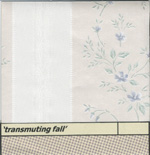
Clarinette is Dan Vallor, a Californian who once produced recordings by Game Theory and Thin White Rope, and who makes bizarre and excellent records for an audience of practically no one. (Along with Transmuting Fall, he sent me a compilation of his music marked “CDR only edition of 5: 2/5.”) Clarinette emerged in 2002 with the wonderfully impenetrable Haze 12”; recent months have seen the release of the Little Fluttery Screamy Thing 7” and Transmuting Fall, which are just as good and only a little less strange.
Clarinette’s music is so successful because it walks an extremely thin line between being very texturally rich and lovely on one hand and impossible to figure out on the other. Vallor, often playing guitar (although he also uses other instruments, such as piano), usually bathes his music in a mess of echo, often so much that single notes are followed by sprays of decaying notes, much like snare drum hits on dub records.
With Clarinette, though, there isn’t any pop song for the trails of echo to accompany, and unlike many avant-garde records that would be otherwise somewhat similar, Clarinette’s music doesn’t really ‘go anywhere’ or ‘ do anything’ – but neither is it drone music of any kind. I struggle to think of precedents for Clarinette – I’m sure there are some closer ones buried in the noise underground somewhere, but the best I can do is Loren Connors, who makes similarly solitary-sounding solo guitar records that are often smothered in noise (in Connors’ case, it’s tape hiss, not echo).
But Connors doesn’t explore texture the way Clarinette does, and the outpouring of emotion in Connors’ music is miles from Clarinette, whose music barely sounds human. Clarinette’s music is made up of sounds that are usually somewhat familiar, but Vallor otherwise leaves few signposts for the listener. His music is a bit like the sound made by rainfall, which we’d never listen to with the same expectations we’d have if we were listening to an album. Of course, Clarinette records are albums, which means they must have been created for a reason. Part of the pleasure of Clarinette’s music is trying – and failing – to figure out what that is.
Other potential reference points for Clarinette’s music are even more remote; there’s Pole, who also makes records that seem to amble rather than approach the listener directly, and whose records also use trails of dubby echoes, although Pole’s are much more clearly connected to actual dub. There are extended-technique improvisers like Bhob Rainey and Greg Kelley, who sometimes seem to speak to each other in a code that’s almost unreadable. And there’s early minimalism – the circling piano patterns on “A Shining Cord” are superficially somewhat similar to the busier bursts of improvisation on LaMonte Young’s The Well-Tuned Piano, and Vallor strangely begins “Best Minds of My Generation” with the same “Come out to show them” clip that is the basis of Steve Reich’s Come Out.
The facts that these artists are very different from each other and from Clarinette indicate that either I haven't done my job as a critic very well, or Clarinette’s music is pretty different, difficult and strange. I’d like to think it’s the latter. Clarinette continues to baffle and intrigue me. By Charlie Wilmoth
|
||||||||||||||||||||||||||||||||||||||||
|
||||||||||||||||||||||||||||||||||||||||||
| |||||


 Haze
Haze