|
|
 |
Dusted Reviews
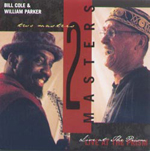
Artist: Bill Cole & William Parker Album: Two Masters Live At The Prism Label: Boxholder Review date: Jul. 18, 2005 |
|
|
|
|
Bill Cole’s previous Boxholder outing Seasoning the Greens is a top-drawer example of jazz-rooted, multiculturally conscious improvised music. Two Masters Live At The Prism, another concert recording by Cole, is not nearly as consistent as its predecessor.
The differences between the two are telling. The first disc featured sympathetic accompaniment from a quintet that included William Parker on bass. It captured a strong performance of a program that Cole had been reworking for seven years, time during which Cole struck a balance between planned and spontaneous events that ensured both coherence and excitement. Its successor, on the other hand, lacks structure and focus; the choice moments are separated by long stretches that are a bit of a chore to hear out. Parker plays a trunkful of exotic instruments besides his bull fiddle; doson goni (a Malian lute that Don Cherry introduced to jazz audiences), nagaswarm (Indian double reed), dunno (talking drum), Indonesian flute and voice. He uses these instruments to good effect on many other recordings, but here his heavy reliance on them dilutes the direct and virtuosic communication that's at his fingertips when he plays his main axe.
The album opens strong, with a dynamic didgeridoo and doson goni dialogue that manages to surprise despite each instrument’s somewhat limited (and in the didgeridoo’s case, cliché-ridden) range of sounds. “Ojibwa Song” also strikes sparks when Cole’s short, breathy phrases on a Ghanaian flute dart in and out of Parker’s dramatically ascending bass figures. But it hits the rocks when Cole starts vocalizing; his actual voice is less appealing that the vocal tones he gets out of his horns. Parker makes the same mistake on “Waterfalls of the Bronx,” which is an exercise in frustration. His bowed bass and Cole’s sona (Chinese double reed) tangle to incendiary effect, but his scatting in the final minutes puts out the fire like a bucket of cold water. Mercifully, there’s no more singing after that, but also no bass.
For the remaining 39 minutes and change, Parker sticks to the little instruments. “Bird and Branch,” a duo for shenai (Indian double reed) and Indonesian flute, is attractively song-like, but the wayward intonation that both men
achieve on nagaswarms on “Election Funeral Dance” gets hard to take; it doesn’t help that their phrases seem directed more at each other than at any broader communication. Cole finds his way clear on “Ending Sequence and Sunset,” using Parker’s simple and aggressive drum tattoos as a solid foundation for dizzying melodic excursions, but at 20 minutes length it’s too much of a good thing.
What went wrong here? The album’s title offers one clue, the players’ utopian liner notes another. Perhaps everyone involved with the project was so in awe of the great masters and their good intentions to point out that this batch has too much exotic seasoning and not enough greens?
By Bill Meyer
|




 View all articles by Bill Meyer