|
|
 |
Dusted Reviews
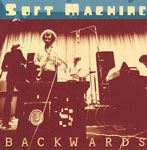
Artist: Soft Machine Album: Backwards Label: Cuneiform Review date: Jun. 13, 2002 |
|
|
|
|
Formed in 1966, Soft Machine – named after the novel by William Burroughs – certainly rank among the most influential “out” rock bands. From the band’s beginnings through its official end in the late 70s, the band changed lineups often, but there’s no doubt that drummer/vocalist Robert Wyatt was the soul of the band.
The six tracks here primarily document a brief but productive period, from 1968 to 1970, collecting three long tracks from 1970 when the band was a quartet; two from 1969 as a septet; and a demo recording of “Moon in June” as a trio.
The liner notes are extremely useful as a background, providing a feel for the era and the activities of the band during the period documented. The only slight frustration is a lack of recording information: it’s actually not clear whether these recordings were made live or in a studio, or who recorded them, aside from a note that the 1970 recordings are in mono (though the quality is excellent).
In any case, the quartet tracks, from May 1970, comprise nearly 40 minutes of flowing, restless experimentation. Echoing the electric fusion experiments of Miles Davis, the band effortlessly combines virtuosic flights of fancy with hard and heavy workouts. Wyatt’s drums rustle and dash about, while Hugh Hopper’s bass pulses, drones, and sometimes bursts out in full-fuzz attack. If there can be said to be a lead instrument, perhaps it’s Elton Dean’s sax, and while Mike Ratledge’s piano and organ often helps hold down the foundation, he also spends plenty of energy giving the sax a run for its money.
The nineteen minutes of “Facelift” ebb and flow, but the energy is primarily high. It’s all definitely jazzy, but the band explores atmospheres ranging from mournful to edgy, and they hit changes together as tight as can be. "Moon in June," here much shorter than the demo at the end of this CD, starts out with alternating blasts of intensity and feints at calm floating. The final piece from this set, "Esther's Nose Job," is 13 minutes of fast-moving rhythmic charge with the lead alternating between sax and keyboards.
The two shorter tracks from 1969 feature the band as a septet. The quartet from above is augmented by Mark Charig on trumpet, Lyn Dobson on sax, and Nick Evens on trombone. Borrowing this brass trio from the Keith Tippett Group really gave the band a different feel, somehow more prog-rock yet also far jazzier. “Facelift” here is much shorter than the first version, and immediately falls into a pronounced swing thanks to the horn section. The recording quality here isn’t as good, lending the bass and keyboards a bit of murkiness, but nevertheless everything’s still pretty much there. "Hibou Anemone And Bear" opens with a rather punk-rock (for 1969!) fuzz bass before the horns come in and things get proggier. It’s almost well-mannered; with the brass instruments it somehow resembles a 70s cop drama soundtrack.
The final 20 minutes here are a demo recording of "Moon in June" from 1968/69, the first half of which was recorded by Wyatt alone. He then brought it back for Hopper and Ratledge to play on the second part. This is definitely a "song" – it has a strong compositional feel rather than being a structured jam. Wyatt's vocals are honestly not particularly strong, but he has a good feel that works well nonetheless. The keyboards are somehow more “of the time” than on the earlier tracks, but are nicely done. The latter half of the song, on which Hopper and Ratledge play, gets very intense and heavy – really great work.
Whether or not this would be a good introduction to Soft Machine for those not yet familiar with the band is difficult to say. I suspect that either Spaced or Volume Two would be a better bet. But though this is more of a completist document, it certainly won’t chase anyone away, as it’s full of consistently compelling musical exploration. Certainly a wonderful contribution to a legendary band’s legacy.
By Mason Jones
|




 Live in Paris