|
|
 |
Dusted Reviews
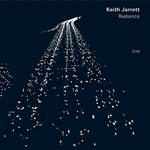
Artist: Keith Jarrett Album: Radiance Label: ECM Review date: Jun. 2, 2005 |
|
|
|
|
Solo albums necessitate a prominence of ego. Alone, without a band as sounding board, an artist must depend solely on his own devices and ingenuity to carry off a program of music. A chief challenge lies in preventing this self-reliance from devolving into self-absorption. Pianist Keith Jarrett has wrestled with this problem for much of his career, occasionally toppling over into autocratic loftiness to the chagrin of both fans and critics. The self-inflating admonishments that pepper his pronouncements to an insouciant Village Vanguard crowd on Fort Yawuh are still off-putting today.
Radiance flips the calendar forward three decades, but the vestigial evidence of the same ego-driven tropes still cling tenaciously to Jarrett’s music. The program comprises music from two Japanese concerts recorded three days apart in 2002. The bulk of the set, all of the first disc and roughly a third of the second, documents an extemporaneous corpus where one piece dictates the content of its successor. As Jarrett himself describes it: “everything on these discs is completely improvised.” That dictum unfortunately leads to a fair bit of tedium as Jarrett’s fingers parse out patterns that range from the repetitious to nigglingly prolix. Several audience members add their own aural stamps to the canvas with inopportune coughs. Jarrett’s own penchant for wordless moaning as underscore to his peregrinations also muddies the music.
Those are the subjective downsides to the set. The prizes reside in Jarrett’s resolute ambition and execution. Demanding of both purveyor and patrons the music unfolds in grandiose slabs that employ the full keyboard range. Rumbling block chords buttress Jarrett’s rifling right-hand runs, regularly setting up dark rondo chases. Melody plays a principal part throughout the program along with a very American, almost bucolic style of expressionism. The gorgeously tuned grand piano ensures that the ad hoc assemblages of notes are birthed with pristine clarity and precision. Coupled with the usual impeccable ECM fidelity and enveloping venue acoustics, the transportative properties of the music are near perfect, better than a front row seat in the respective recital halls. Numerous episodes of lyrical beauty arise, along with a fair amount of moody argumentative interplay between Jarrett’s studied hands. Considered against the sprawling weight of its predecessor, the second Tokyo concert can’t help but seem a bit like filler. But its pleasures prove manifold as well.
Clues to Jarrett’s pointed preoccupations with self may be present, but there’s no denying his consummate command of the keys. Few players achieve the level of instant and pervasive rapport with instrument that is his routine province. Despite its occasional foibles, which are more cosmetic than anatomical in nature, this set establishes another ironclad stanchion in support of his place as one of the pre-eminent pianists of his generation.
By Derek Taylor
|




 View all articles by Derek Taylor