




|
|
|
|
|
|
|
|
|
|
||||||
| |||||
|
|
||||||||||||||||||||||||||||||||||||||||||
|
|
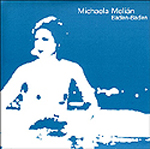
There's a lot to say about Michaela Meliàn, but none of it really helps discussing her solo debut. Her F.S.K. membership alone warrants enough interest to check out Baden-Baden and her abstract feminist installation art could refer in an oblique way to her recontextualization of contemporary minimal house music. What's important to know about her, for now at least, is that she's managed to make her maiden voyage into electronic music staggeringly pretty.
Produced with fellow F.S.K. member Carl Oesterhelt (a.k.a. Carlos Fashion), Baden-Baden is not full of surprises. Borrowing structurally from minimal dancefloor aestheticians, new sounds enter the picture deliberately, almost predictably, finding themselves closely hugging simple rhythmic structures. Preset-style synth bass stabs alternate with a standard 4/4 kick, and emotion-ridden melodies build up block-by-block. But there's nothing stagnant about the feeling here - in a Kompakt-colored time when it's easy to do an album of straightforward banging, Meliàn takes the well-worn palette and casts it in a light that invites concentration more than motion. Broken chords fade forcefully in and out next to preset sounds that would normally generate anthemic trance or happy hardcore.
Stuttering instrumental samples and a laid-back drone on a few tracks ("Verkehr," in particular) recall the feeling of Howie B's Turn the Dark Off without the hustle of breakbeats. Meliàn's training and affinity with classical instrumentation ends up playing well around Oesterhelt's simple techno aesthetic - as an example, the wind-up music box bells in opener "Brautlied" would incense fans of Moondog's "Elpmas" compositions and, sped up significantly, would make an ear-catching curveball for any eager-to-please club DJ.
The standout here is the notably aggressive "Ignaz Günther Haus." Meliàn balances a simply arpeggiated minor chord, long-bowed strings, and glittering synths in a nine-minute stomper. The track reaches briefly into dark clipped bass, tossing in randomized high-frequency squeals toward the end. By the time it reaches the handclap-studded climax, a lingering realization sets in - this album would actually fare quite nicely in da club.
A beatless version of the Roxy Music standard "A Song for Europe" ends the album differently - it's the only track on Baden-Baden to feature Meliàn's voice, lodged somewhere close to Nico's signature inflection with a touch of labelmate Barbara Morgenstern's Deutsche-English directness. The cover is odd coming off of an entire album of 4/4, but it does seem a very fitting place to end up. Accompanied only by simple string arrangements, it's a testament to Meliàn's subtle emotion that "there's no more time for us / nothing is there for us / to share but yesterday" doesn't seem tired or kitschy. Even the quaking violin swells don't overstep any unexpected emotional boundaries.
Despite all its regularity, Baden-Baden ends up being anything but formulaic. Michaela Meliàn disarms the time signature, breaks down the house structure and recompiles it in a way that's so familiar and attractive, you don't think twice about it. The beats, in the end, justify their existence in that rearranged familiarity – they anchor the sounds above and around them, and keep the delicate melodies from floating off into the ether. By Trent Wolbe
|
||||||||||||||||||||||||||||||||||||||||
|
||||||||||||||||||||||||||||||||||||||||||
| |||||


 View all articles by Trent Wolbe