|
|
 |
Dusted Reviews
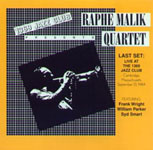
Artist: Raphé Malik Quartet Album: Last Set: Live at the 1369 Jazz Club Label: Boxholder Review date: Oct. 31, 2004 |
|
|
|
|
On paper and in practice, the band assembled on the Last Set: Live at the 1369 Jazz Club carries powerhouse clout. In Fall of 1984 when the music was recorded, Trumpeter Raphé Malik was in the midst of his fertile association with Jimmy Lyons post-Cecil. Saxophonist Frank Wright, stateside for a stint, still had command of his Ayleresque powers. Bassist William Parker held about a decade of professional playing under his belt and drummer Syd Smart (recently featured to fine effect on portions of the Jimmy Lyons Box from Ayler Records) sustained a similarly youthful and hungry viscerality in his stick work.
The trio, sans Wright, was a regularly working group. Their music captured at the small Cambridge club was one gig among many. While undeniably intriguing from a historical standpoint, the set's three long cuts carry the patina of a typical club date. Granted, typical for these guys isn't anything to scoff at, but considered under the umbrella of their larger careers this particular snapshot feels a shade habitual. Some audio blemishes also mar the fidelity, but given the vintage of the tape their presence isn't unforeseen.
"Sad C" opens with a morose unison theme in line with its title, swiftly diverging into a lengthy solo spot for Malik, who milks downcast clusters of notes from his brass as Parker and Smart provide saturnine support. Laced with an impressive amount of tonal control and some electrifying passages, the leader's improvisations still err into the overly verbose. Parker closes the piece with some delicate kalimba-like harmonics before a lugubrious return to the theme.
"Companions #2" consumes nearly a half hour, building from a hoary solo from Wright peppered with honks, bleats and vocal exclamations that draw liberally on his R&B roots. A stretch of combative tandem blowing gives way to another stentorian turn by Malik, who digs in with a declarative statement that keeps the group tension taut. Wright soon caps his reed and speaks in tongues over a rosin-smoldering arco line by Parker that leads into a clever colloquy between bass and drums. A break by Smart leads to an about face in temperament with Wright mitigating his previously harsh tone with some straight riffing atop a vaguely-Latin vampish groove. Malik is equally methodical in his second solo, voicing his flashy tickertape notes with a purposeful demeanor. Parker closes the piece with a corpulently plucked coda that segues to a terse band sign-off. At a brisk 10 minutes, "Chaser" caps the set as an encore with more fireworks from Malik, some gruffly enunciated blues vocalizing from Wright and another spate of fine tenor blowing.
As a whole the performance is far from a bust. But the feeling that it's not that far from par for the course for these guys circa 1984 lingers after the last note is played. Levied against their other work as individuals before and since, it registers as little more than a middleweight entry.
By Derek Taylor
|




 View all articles by Derek Taylor