|
|
 |
Dusted Reviews
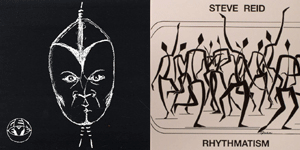
Artist: Steve Reid / Marcus Belgrave Album: Rhythmatism / Gemini Label: Soul Jazz Review date: Sep. 27, 2004 |
|
|
|
|
Rhythmatism and Gemini are similarly vamp-heavy jazz records from the mid-1970s that have recently been reissued by Soul Jazz. Of the two albums, 1975’s Rhythmatism features the biggest names – Arthur Blythe plays alto throughout the record, and former Albert Ayler sideman Charles Tyler stops by to play bari on “Center of the Earth.” Despite the presence of relatively well-known players, and despite the fact that drummer Steve Reid is credited as the leader, it’s pianist Les Walker who’s most prominent: he wrote four of the album’s five tunes.
Reid, for his part, grooves away throughout the album, even through most of Walker’s aggressive free solo on “C You Around” (which, despite the fact that Blythe and Tyler will be best known to Dusted readers as free players, is one of only a couple of out moments here). Reid plays in a half-jazz, half-rock style that suggests he was paying attention to Miles Davis fusion experiments from around the same time. Walker and bassist David Wertman follow Reid with such enthusiasm that it occasionally causes their levels to peak, resulting in distortion.
Gemini, from 1974, is very much of its time – its opening track, “Space Odyssey,” even begins with siren-like, dated, and presumably “Space”-y synths from Daryl Dybka. And Harold McKinney’s electric piano has the Fender Rhodes sound we’re used to hearing from jazz records from the '70s. (McKinney does a much better job tailoring his playing to the capabilities of the electric piano than most pianists of his time, and his work on Gemini sounds lovely.)
Whatever its connections to the era in which it was created, though, Gemini is a fine record. Leader Marcus Belgrave’s arrangements for his horn players (himself on trumpet and flugelhorn, Wendell Harrison on tenor sax, and Phillip Ranelin on trombone) sparkle. And all three sound like they’re having a lot of fun with the material (check out Harrison’s loopy glissandi at the beginning of Part II of “Glue Fingers”).
Like Rhythmatism, Gemini is groove-heavy, but it’s more restrained even though its forces are much larger. The huge rhythm section (drummers Roy Brooks and Billy Turner, percussionist Lorenzo Brown, bassist Ed Pickens and McKinney are all present, and the three horn players also play percussion) generates a lot of sound without losing the clarity of its individual parts. Some tastefully applied reverb allows Belgrave’s trumpet to ring out over the other instruments. Gemini may remind you of most of the things you've liked about '70s jazz.
By Charlie Wilmoth
|





 View all articles by Charlie Wilmoth