|
|
 |
Dusted Reviews
Artist: Gang Gang Dance Album: Revival of the Shittest Label: The Social Registry Review date: Oct. 19, 2004 |
|
|
|
|
Tzvetan Todorov, notable Bulgarian literary theorist and “culture critic,” sent seismic ripples up the seat of collective theory’s slacks when he published his bizarre analysis of Boccaccio’s Decameron. Instead of “unpacking” or “deconstructing” the work, Todorov saw it, prima facie, as a collection of words.
Of course, all writing is a slew of sentences, but Todorov broke the book down as a butcher does a carcass. Boccaccio’s characters were carved free of their craft; attributes became puddles of adjectives; proper names became as nominal as nouns; actions lost their voices and became verb’s predicated act. Through Todorov’s lens, the Decameron isn’t so much a collection of 100 novelle, it’s rather one single sentence, a diarrhetic discourse sweeping up “structuralist” notions like so much of ephemera’s detritus.
In this sense, language isn’t relegated only to a medium; it’s the subject proper. Therefore, the sentence nods twice: (i) to its subject, and (ii) to its very structure, granting the reader of its words two windows on the syntactical world. This is not a new enterprise; before language theorists were chewing up texts, the Greeks had their play with the phoneme, such efforts that were cherished mightily during the Renaissance and the so-called “Flowering of New England.” Appropriately, R.W. Emerson extrapolated on language’s vegetal quality. Our minds, according to Emerson’s take, were like soil aching for seed. If Emerson was correct in asserting that language was the bud of thought’s blossom, it must be raining flowers in New York City.
Falling flowers or not, it’s easy to locate the loci of folks like Animal Collective, Black Dice, and Gang Gang Dance. Their music shares sound in such similar ways that their residences - and aesthetic - must have risen from selfsame preternatural soil. Yet, while their recordings proper aren’t wholly mimetic, their processes are: All three of these groups handle sound much in the way Todorov handled the Decameron’s language. Sounds are extracted from their “popular” context and re-contextualized in a way that says as much about the sounds themselves as it does the “finished” work they comprise. Granted, this method doesn’t always yield exciting results; but when it does, it can be practically coruscating.
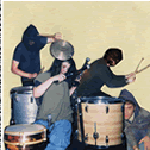
Gang Gang Dance’s Revival of the Shittest, Social Registry’s LP reissue of a CD-R self-release, does some pretty brilliant things with some pretty un-brilliant equipment. Throwaway keys, ad hoc percussion and a panoply of near-death DOD FX pedals tinkle, twitter, thud and rumble. Knobs are tweaked; keys are caressed and crushed; drums are dub’d and numbed with flurries of nimble wrist’d scatter; bass lines stretch like a Terry Riley comp blown into gobs of white-hot glass stretched around the world’s waist. Vocals, when they do swim above all the different dins, are mostly unintelligible: Ono-esque lyric-less lyrics, singing as sound, etc.
Of course, this is a mixed bag: there are improvisational melees, dub-ish incantations, percolating postscripts to extended epistles. Yet, this is decidedly invigorating music: one’s privy to music made in so many different instances and in so many different fashions, that the end result is something like listening simultaneously to five different Thinking Fellers Union records while the next-door bars’ arcade games eviscerate one another. And, for all the overheated talk, there are analogues. There’s the obvious, like the nitrous oxide drenched dub of Lee Perry, or King Tubby. There’s the less obvious, like the elementally subatomic free-jazz of Lowell Davidson; and then there are the lesser obvious, like the minimalist ‘80s electronica of Geile Tiere, Vice Versa, or Weltklang. But, like the best ensembles, Gang Gang Dance gulp down this disparate sustenance and spit it out in a wildly original upchuck as solid as it is liquid. There’s stuff to cling to even when the prospect of slipping is certain.
Revival of the Shittest isn’t as focused, or as coherent a work as, say, their recent full-length recording for Fusetron, yet these aren’t characteristics striven for here. Revival’s instrumentation shies from taxonomy, preferring perplexing morass to a simplistic, or palatable explanation. Revival, as its name suggests, is a restoration of sorts; this is the tonal reevaluation of elemental music, the nuts ‘n’ bolts of instrumental and vocal sound. And once grasped, Revival works as a prolegomena to the Fusetron recording. This is the language one will be dealing with; these are the techniques - the tropes - Revival seems to say. These are sonic reductions, the elemental exercises breaking down the overwhelming amount of de trop recordings that so often sound as if they were spun from the selfsame aural wool. Like Todorov and his Decameron, Gang Gang Dance is capable of sounding narrative into one self-aware, serpentine sentence. And with Revival, they begin the documentation of sound’s syntactical breakdown, an enterprise that thankfully did not end with Todorov’s “meddling” literary theory.
By Stewart Voegtlin
|





 Gang Gang Dance