|
|
 |
Dusted Reviews
Artist: Le Doigt de Galilée / BNSF Album: Object 5 / Object 6 Label: Locust Review date: Sep. 19, 2004 |
|
|
|
|
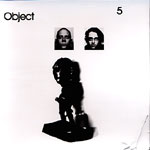
Locust’s Object series may not be the most boisterous of musical projects, but the installments represent one of the most interesting serial releases in recent memory. The relationship between the visual and audio aspects of the albums is often a stretch at best (10 points to anyone who can explain what Object 5’s music has to do with a naughty male figurine with a C3PO head), but each album has continued a rather quiet, minimalist look at improvisation. Whether acoustic, electric, or electro-acoustic, the improvisations on the discs are usually devoid of grand gestures, instead focusing on the musical interplay of the instruments at their most basic level.
The fifth release in the series is the first collaboration between English percussionist Nicolas Field and Jaime Fennelly, a Brooklyn electro-acoustic improviser. The duo, performing as Le Doigt de Galilée, create some of the Object series’ most microscopic music, with the electronics often reduced to an almost inaudible squeal, and Field’s percussion used more as ambient sound than any sort of rhythmic base. Field's cymbal scraping and the shallow washes of his more resonant work on the platters makes way for a rapid pattering upon seemingly every surface at his command but the drum heads themselves. Fennelly's high-frequency electronics are often a thin whine, though his best work is with the more abrasive material; his command of the arcing static of connections made and broken often sears the music with a miniature, though sometimes intense, sense of aural shock. The more ambient side of Object 5, however, is the most prevalent, with music that hinges on inaudible undulations to create a false sense of continuity within the sound. Light, rapid cymbal taps or the ebb of a sine wave in and out of the upper registers of human audibility create a haze, almost like a mirage; definitely existent, but not so opaque as to keep listeners from second-guessing their own ears. The high-pitched electronics can fill a room with a palpable tension, and have a surprisingly physical presence within the listening space. It's impressive that music that forces the listener to struggle just to hear it can sometimes be just as hard to ignore.
The trio of Adam Diller, Matt Crane and Jason E. Anderson are responsible for some of the Object series' most organic sounds, even more so than Fred Lonberg-Holm and Axel Dörner's cello and trumpet on the initial Object offering. The basis of BNSF's music is in saxophone, guitar, and drums, though electronics and electro-acoustic sound manipulation also have their place. What sets this Pacific Northwest trio apart, though, isn't simply the instruments they play, but their approach to traditional free-jazz improvisation. Their output isn't like the stormy bluster, "R.W. Sarber et al. Killed a Virulent Strain of Tubercle Vacilli and BCG by Ultra-Voilet Light," but BNSF never depart completely from the realm of jazz-influenced improv into the more sterile, refined environs that marked most of their predecessors in the Object series. There are moments, of course, when Diller's saxophone or Anderson's harmonica are reduced to almost incognito buzzes and drones, and Anderson's guitar undergoes plenty of masking on much of the disc, but, due in part to Crane's percussion, Object 6 retains a living, breathing feel. The changing locations of the recordings also give life to the music, especially during "Domani é Troppo Tardi," when the sound of passing traffic underlies the musicians' soft conversation. While it's the series' least distinctive disc, Object 6 remains a novel signifier of the newest trends in improvisation, and a fitting successor in Locust's ongoing Object explorations.
By Adam Strohm
|




 View all articles by Adam Strohm