




|
|
|
|
|
|
|
|
|
|
||||||
| |||||
|
|
||||||||||||||||||||||||||||||||||||||||||
|
|
Chess Records, the Chicago label founded by Polish-American brothers Leonard and Phil Chess, is best known for its legendary recordings by Howlin’ Wolf, Sonny Boy Williamson, Muddy Waters, Bo Diddley, and Chuck Berry. These artists all recorded for the label in the 1950s, and their individual contributions to Post-War Blues and Rock & Roll history cannot be overstated. Critics try, however – the label’s history is exhaustingly documented in copious articles, books, and anthologies.
Very few of these surveys, however, extend past the close of the Eisenhower era. For blues purists, the 1960s were a time best forgotten, a decade of decline in whatever it was that made the blues authentic. Mike Rowe in his Chicago Blues calls the ’60s “a very sad period” for the bluesmen of 2120 S. Michigan, and the same sentiment infects curatorial choices. Howlin’ Wolf’s His Best, for example, contains nothing recorded after ’64 and insists that “the era’s changes did little to enhance Wolf’s music.” Antipathy by Blues purists, coupled with the attention that Motown, Memphis, and Chicago’s Curtis Mayfield generated in the ’60s, has served to overshadow some of Chess’s most adventurous music. Soul Jazz’s Chicago Soul compilation reminds us that the label grooved through the ’60s without missing a beat.
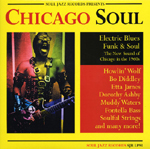
Chicago Soul is much more than a blues compilation, but the blues are at the heart of a roster that blossomed outwards into soul, funk, psychedelic, rock, and other styles. It’s significant, then, that this collection opens with “Evil,” a Howlin’ Wolf staple, and that the included version, recorded in 1968 (during “the nadir” of Wolf’s career, according to those aforementioned liners) ties the familiar classic in knots. In ’54 Wolf moaned feverishly about the back-door man slinking around his bushes. Accompanied at the time by a sympathetic instrumental backing – tinkling piano, guitar, bass, and mouth harp – 1968’s version sees the addition of bowed and fuzz guitar lines which float playfully around the hapless Wolf. I’ve always pictured the “Evil” adulterer as a postman, but this new guy’s clearly wearing a peacock shirt and jiving through the backdoor of Wolf’s “happy home.”
From “Evil” on, Chicago Soul develops like an energetic conversation, a bantering of styles and themes that reaches into every niche that 1960s Chicago had to offer. In this way Soul Jazz does more than fling a lot of great music at us – they sequence it so that its momentum follows strands and achieves a cumulative meaning. Bo Diddley retells Wolf’s cuckolded blues over his trademark rock shuffle, all amped up this time (“I don’t understand it / The thought of my baby being with another man”). You can follow him right into the understanding arms of Chess diva Etta James. Included is the title track from her Muscle Shoals-massaged Tell Mama, which coos with a pinch of maternal assurance and a pile of ripe sexuality (“Tell mama / All about it / What you need / What you want / I’ll make everything al-right”).
Hitting with this 1-2-3 punch from the start, Chicago Soul proceeds to illuminate some of the more divergent areas of the late-’60s Chess catalog. Rotary Connection’s 1967 “Memory Band” – arranged and produced by Charles Stepney – retains little of Chess’ bedrock ’50s sound. With its eerie electric sitar, slanted orchestral arrangements, and Minnie Riperton’s trippy, childlike vocals, the song anticipates Stereolab more than it reiterates Chuck Berry. Producer Richard Evans fleshes out Ramsey Lewis’ swinging “Party Time” with a lean horn section and a lively, towering percussion, and injects a cool psychedelic haze into offerings by Dorothy Ashby and The Soulful Strings.
Marshall Chess, who became more active in his father’s label during the 1960s, describes the era as one of unbridled creativity: “All the records I made were radically different, you know, but you could do it because we could get it on the radio, we could see what we had.” Chicago Soul is like a mad, wonderful dash through the heart of this era. Every track is an invitation to explore a whole catalog; compiled together they tell the story of a label that wouldn’t declare an end to its prime, 10 years after the blues writers had written them off. By Nathan Hogan
|
||||||||||||||||||||||||||||||||||||||||
|
||||||||||||||||||||||||||||||||||||||||||
| |||||


 View all articles by Nathan Hogan