|
|
 |
Dusted Reviews
Artist: Cecil Taylor Album: Algonquin Label: Bridge Review date: May. 26, 2004 |
|
|
|
|
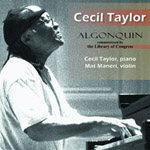
In the summer of 1988 Cecil Taylor took part in a pivotal project in Berlin. Over the course of a month he collaborated with an assemblage of European improvisers. The tenure yielded an 11-disc box set for FMP dominated by duos between the pianist and various foils, mostly drummers. Since that residency, Taylor has rarely returned to the duo configuration. To my knowledge there aren’t any commercially released recordings pairing him with a fellow American in this context. Algonquin, released by the adventurous classical music label Bridge Records, is the first of its kind in this regard.
How often does a person get to hold court with one of his or her heroes? The opportunity visited violinist Mat Maneri on February 11, 1999 at the Library of Congress when he convened with Taylor to realize a ‘composition’ commissioned by the library’s McKim Fund. Taylor had Maneri rehearse rigorously the day of the performance, right up until just prior to the concert’s start time. The regime was as unremitting as it was puzzling, adding to Maneri’s anxiety as well as taxing his faculties to the point of exhaustion. But once the curtain drew back and two began to converse on musical terms in front of the audience, Taylor’s recondite tactics paid off.
The piece is parsed into four segments with the first part annexing nearly a half hour, followed by two short transitional solo sections and a conclusion that is roughly half the length of the opener. On the first of the solo pieces the pianist serves up some of his most lyrical and restrained playing on record, ending with the audible shuffling of score papers, an ironic gesture not lost on the audience. Maneri takes the second.
Taylor lights the fuse for the program prior to that with a brief prefatory poem before deferring to Maneri’s sliding tonal squiggles. An audience member erupts in enthusiastic applause, presumably responding to a visual dance cue from Taylor lost to the recording and Maneri’s lines gain confidence, velocity, and piquancy. Taylor reappears, this time plucking his piano strings like a zither and creating a sparse complement to Maneri’s ruminative patterns. It’s here that an intrusive buzz, likely a culprit of Maneri’s amp, undercuts the interplay slightly. But as sudden as its arrival, it’s gone, returning again only for a portion of “Part 3.” Taylor’s switch to ivories proper signals an increase in tension and density as the two match wits in a jousting game of revolving contrapuntal lines. A Baroque sense of theatrics informs the exchange with Taylor running strenuous laps with his keys and Maneri keeping pace right along side him with undulating harmonic ribbons that braid in-between. The pair’s call and response volley reaches gloriously dizzying heights leavened by periodic divergences into comparatively conciliatory romanticism.
On the surface Maneri seems an odd match for Taylor. His approach on his strings is often one of gradation and nuance, a drawing out and a reeling back of posited harmonic information, insinuating into the crevices between tones in a style weaned from his father, master-microtonalist Joe Maneri. Taylor deals in epicurean detail too, but often tempered through a churning funnel of kinetic energy, chordal clusters swirling in torrents like layers of surf whipped to froth in a tsunami. On the level of apparent opposites the two find a mutually inspiring fit with Maneri embellishing and augmenting Taylor’s terpsichorean patterns and the pianist, in turn, goading his younger liege into some terrifically animated acrobatics with bow. In addition to offering yet another example of Taylor irrepressible art, this recording also points to the impressive improviser Mat Maneri was five years ago. It’s a level of skill he’s only managed to enhance in the ensuing years and leads one to wonder – when will we witness the rematch?
By Derek Taylor
|




 Almeda