|
|
 |
Dusted Reviews
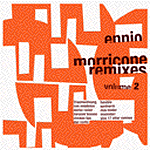
Artist: V/A Album: Ennio Morricone Remixes volume 2 Label: Compost Review date: Mar. 21, 2004 |
|
|
|
|
When I say the name Ennio Morricone, what immediately comes to mind is his melodies, especially from his soundtracks to Sergio Leone’s spaghetti westerns. You’ve all heard them, even if you don’t know it (especially the theme to The Good, the Bad, and the Ugly). But what a passive listener often overlooks is that the melodies are only half of the music. The reason his scores fit so well with Leone’s films is that the two of them share a similar core aesthetic: creating spaces that are simultaneously epic and intimate, exploring the claustrophobia of silence, and showing that the pulp and the popular can be just as expressive as anything else. Anyone can create a memorable melody, but only Morricone could take that melody, stretch it over the wide palette of a Leone panorama, and imbue it with equal parts irony, humor, and emotional weight. The music has a certain inevitability and completeness about it, taking the elements and instruments of popular Americana and expanding their possibilities. It’s that very depth beyond the simple melodies that makes his music so respected.
But it’s that same depth and completeness that makes remixing Morricone so difficult. For a remix to work well, the remixer must first have a full understanding of the music they’re undertaking, allowing the remixer to be able to comment on the original and make it something more. You can’t just take samples from something and put them over a new beat, primarily a facile exercise in the “ain’t-it-cool.” And therein lies the biggest flaw with this two-disc compilation of Morricone remixes. None of the remixers here really took the time to understand what makes Morricone’s music work. Granted, the explicit intent of this compilation was to take his music and put it over various types of dance beats, and in that regard, they’re fairly successful. I’m no judge of most European style dance music, but to my taste, if I heard any of this come on in a dance hall, I wouldn’t have a problem with any of it. In fact, I probably wouldn’t even know that Morricone was even at play.
Fundamentally, this compilation has nothing to do with Morricone; all of the producers here are basically doing what they normally do and smacking a few samples (including the aforementioned The Good, the Bad, and the Ugly). Most of their samples are from lesser-known soundtracks, and the samples themselves are almost totally lost in a sea of breakbeats, synthesizers, and dance music clichés. By the end of two full CDs (actually four, since this is the second volume in the series), I’m left wondering why exactly these producers wanted to pay homage to Morricone.
Given the opportunity, I would love to hear a true set of Ennio Morricone remixes done by musicians who actually add something to the originals – artists like Matmos, Aphex Twin (circa 1989) and Otomo Yoshihide. They at least have the ability to give this music the treatment it deserves, highlighting the subtleties and nuances while also enhancing and properly recontextualizing it. I guess what bothers me most about this compilation is its intent: Morricone wasn’t, isn’t, and never will be dance music, and to spread it like a condiment over otherwise generic, mindless dance music misses the point entirely. There’s no pressing need for the world to hear this.
By Dan Ruccia
|





 View all articles by Dan Ruccia